I just discovered this today. If you haven’t read this before, read on, it’s excellent. Reminds me of my theory of the giant green slime behind Pluto that controls us all…
What People Make – Salary Post
A friend of mine asked me to dig up information on salaries in various fields recently. In the US, salary information is jealously guarded, which makes it more difficult for students to weigh their career options. When data is available, it varies in quality, and often shows median salaries, whereas most people are interested in salary data based on data from their peers. I pulled together data below from personal experience and articles I’ve read. Bear in mind that the peer group in mind is those individuals graduating towards the top of their college class, having gone to an elite university, or otherwise possessing similar talent.
Read the full entry (600 words) …
Rural Poverty and Development
A friend of mine sent me a link to Kiva.org the other day, which is an innovative organization providing a peer-to-peer lending conduit between first-world benefactors and third-world entrepreneurs. Individuals can learn about individual entrepreneurs and their loan needs, and decide to loan them money with the click of a mouse.
Read the full entry (470 words) …
The Myth of Energy Independence
“We’ll grow our own energy right here in America, and stop sending our money to the Middle East!” This refrain has become very common in the US energy debate going on today. Coal producers are lobbying for increases or extensions to programs that subsidize the cost of turning coal into diesel fuel, and corn growers have successfully lobbied for a 51 cent-per-gallon subsidy on gasoline-ethanol blends (sometimes containing as little as 1% ethanol). Meanwhile, politicians proclaim that our dependence on foreign oil is a threat to national security.
Is the answer to America’s energy needs really to grow or drill it all at home? And would doing so help moderate the rapid rise in gasoline prices, and in energy costs as a whole? These questions deserve further review.
Read the full entry (371 words) …
Top Five Worst Subsidies
Anyone versed in basic economics knows that government subsidies are almost always a bad idea. To be sure, government support can be crucial in furthering basic research and other beneficial activities that for-profit corporations avoid. But it’s a sad reflection of America’s budget process that we continue to subsidize activities that are well established and often highly profitable. In other cases, we taxpayers distort costs through our subsidies, thus encouraging over-consumption of a subsidized good relative to an unsubsidized one.
While many articles on this blog have been devoted to the topic, I couldn’t resist – so here’s my top-five list of most-reviled government subsidies:
Read the full entry (341 words) …
Fatten us all with Farm Subsidies
This New York Times Magazine article does an excellent job of exposing how farm subsidies have contributed to obesity amongst Americans, and particularly amongst America’s poor.
In a nutshell, by subsidizing the overproduction of corn, soybean, and wheat, the American government drives the cost of these staples down, which in turn encourages overconsumption. All the extra caloric energy produced by America’s subsidized farmers gets translated into Twinkies, candy, potato chips, and myriad other junk – junk that interestingly offers far more calories per dollar than more healthy foods. The junk food fits perfectly into a low-income budget, which helps explain the paradoxical poverty-obesity correlation in the US.
Read the full entry (321 words) …
Is Private School Worth It?
The choice of school for one’s children is a very personal one, and is heavily influenced by one’s own childhood experiences. It’s probably true that most parents who went to private school themselves intend to send their kids to private school, and that most public-schooled parents intend to do the opposite. But leaving out for a moment considerations of prestige, status, diversity, and the like, is paying $20k a year for thirteen years of a top-notch private school worth it?
Read the full entry (413 words) …
The Earth is Not Dying
In addition, we cannot cannot destroy the Earth. It’s highly unlikely that humans could even end life on Earth, even if we gave it our best shot (unless Darth Vader loans us a Death Star). Total nuclear holocaust (the simultaneous use of all nuclear weapons on Earth) would lead to the death of most, and perhaps all of humanity, but the Earth would still be around. In perhaps a few decades, and at most a few hundred years, Earth would be teeming with life again. Sure, most of us complex vertebrates would say adios, but give the planet a bit of geologic time, and something equally interesting would probably replace us.Why do I bring this up? With the reemergence of global warming as a major issue in the last few years, alarmists are again making grandiose claims that we’re killing the planet, or that we’re going to destroy life on Earth. Hyperbole may be a way of getting attention (like the title of this post!), but it also tends to discredit an argument. When environmentalists scream that we’re killing the Earth and need to change our ways, what do people do? They tune out.
Read the full entry (308 words) …
Tax Pollution Bumper Sticker
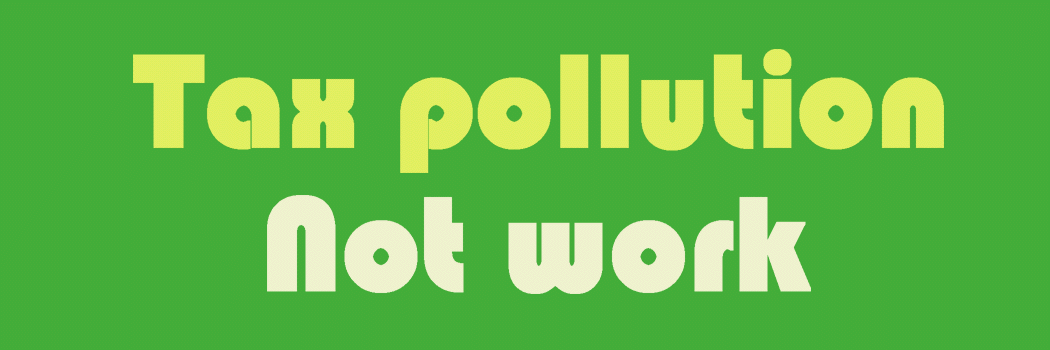
This is a bumper sticker my wife made – I thought it was pretty cool. Here’s a link to CafePress to get it. Talk amongst yourselves.
Tax Pollution, Not Work
How could it possibly be a bad idea? Environmental pollution is the largest single economic externality faced by modern market economies like the United States. Households and companies alike do not suffer direct costs for their pollution, and therefore have no incentive to curtail it. Meanwhile we all suffer its negative effects, which include increased rates of asthma and respiratory illness, and also include rising temperatures worldwide.
Read the full entry (365 words) …
 True Cost - Analyzing our economy, government policy, and society through the lens of cost-benefit