What’s the Real Unemployment Rate?

The U-5 measure of unemployment stands at 7.5% in October 2008.

The officially reported unemployment rate rose to 6.5% in October 2008, according to the US Bureau of Labor Statistics. The BLS actually collects 6 different measures of unemployment, however, and reports U-3, one of the middle-range measures, as the official unemployment rate. This rate includes those who are actively looking for work, but does not include those who have given up looking because they can’t find a job. The official unemployment rate also excludes those who are working part-time but can’t find a full time job.

So what are the numbers?

October 2008 Unemployment Measures

U-3, Officially Reported Unemployment: 6.5%
U-5, Unemployment Rate including those who have given up: 7.5%
U-6, Unemployment Rate including under-employed: 11.8%

Since most Americans count those who have are discouraged to look for work as unemployed, the U-5 measure is a more accurate measure of unemployment, even if it’s less politically palatable. One percent of the US work force equates to 1.5 million people. So next time you see the headlines, remember to add a percentage point (or two!) when looking at unemployment numbers.

Do Lower Gas Prices Counteract Higher Unemployment?

Gas prices have fallen below $2 a gallon here in Atlanta, and in many other parts of the country. Unemployment is heading in the opposite direction, up to 6.5% at last count. With gas prices dropping so rapidly from $4, how much cushion will this provide for the economy?

The average price of regular gas over the last twelve months was $3.41, and Americans drove roughly 3 trillion miles over that period. If gas averages $2 over the next 12 months, Americans could save $211 Billion on gasoline over the next year, a savings of around $2000 per family.

How does this compare with the economic impact of lost employment? A 1% rise in unemployment corresponds to roughly 1.5 million jobs lost, and $75 Billion in total income lost at average American salaries. If unemployment rises from 5% (early 2008) to 8%, then the $225 Billion in lost wages may have approximately the same size impact in economic terms as the decrease in gasoline prices.

That’s a surprising result – gasoline is so important to the US economy that the drop in price negates a 3% drop in employment! While that won’t solve the problem of global de-leveraging and the credit crunch, it’s a big cushion to lean on.

Sources and Calculations:

US Total Vehicle Miles: http://www.fhwa.dot.gov/ohim/tvtw/tvtpage.cfm

US Gasoline Prices: http://www.eia.doe.gov/oil_gas/petroleum/data_publications/wrgp/mogas_history.html

US Unemployment Stats: http://www.bls.gov/news.release/empsit.nr0.htm

US Total Wage Stats: Bureau of Economic Analysis

Gas Price Savings Calculation: 3 trillion miles / 20 mpg = 150 Billion gallons. 150B gals * 1.41 = $211B. The gas price was measured using the last 12 months to Oct. 31, 2008, from the EIA data above. If there are 100 million families in the US, this equates to roughly $2000 per family. Alternately, if the average family has two cars, and drives a total of 25,000 miles per year, then this equals 1250 gallons, and a savings of $1760.

Lost Wages Calculation: From the BLS, there are 154 million people in the labor force, so 1% rise in unemployment = 1.5M additional unemployed. From the BEA report, total US wages are 8 Trillion, or roughly $50,000 per person. 50,000 * 4.5M = $225 Billion

In comparing the magnitude of the two, both the drop in employment and drop in gasoline prices have multiplier effects on the economy that aren’t measured here. This raw comparison accounts for the first-order effects of both changes on the economy.

US Healthcare Reform: Possible Choices

The United States’ health care system is a patchwork of private care, Medicare for seniors, Medicaid for some of the poor, and emergency-only care for the 47M uninsured. Both presidential candidates insist that change is needed, with increased coverage and decreased costs as primary goals. Neither candidate mentions how public dollars will be rationed, though government resources are limited.

Here’s a list of a range of health care systems in place around the world, with the most market-oriented systems listed first, and the most government controlled systems listed last. The future of American health care will mostly take the form of one of the middle options, as both extremes appear politically unpalatable.

US Health Care System Choices:

Health Care System Description Found Where
Traditional Free Market Little government intervention, patients pay health care providers directly. Those without financial means rely on charity hospitals or receive no care. India, many developing countries
Public Senior Care + Semi-Free Market The government provides health care for seniors, while others rely on a regulated private health insurance market (whether purchased individually or through an employer). United States
Public Care for Children and Seniors The government provides health care for seniors and children, while others rely primarily on the private health insurance market (whether purchased individually or through an employer). Barack Obama’s health care plan approximates this
Mandatory Health Insurance The government requires that all individuals purchase health insurance, and provides subsidies to assist the poor and unhealthy in purchasing coverage. Massachusetts, Hillary Clinton’s Plan
Dual Public-Private System The government provides health care for all residents not enrolled in private care, and provides incentives for employers to provide health care and for individuals to purchase care. Individuals may also pay extra to supplement their basic government plan. Australia
Single Payer, Private Premium Care The government provides health care for all residents, and individuals can choose to pay extra for premium health care services (like private rooms, experimental treatments, etc). France, other European countries
Single Payer Only The government pays for all health care, and does not allow private market health care transactions. Canada

Why does America encourage debt?

America (and the world!) is now being punished for its relentless accumulation of debt during the housing bubble and before. Commentators of all stripes have laid blame for the credit bubble, whether upon Alan Greenspan, lack of regulation, greedy Wall Street, or otherwise.

But it’s interesting to note that US credit bubble has in fact been building for decades, as shown here:

US Household Debt to GDP Ratio

I have a basic question: Why does America encourage debt? Both individual and corporate debt are encouraged through federal and state law, through mortgage interest deductions for individuals, and through similar deductions on interest payments by corporations.

The home mortgage deduction is a relatively recent invention, while business interest has been deductible since the advent of the income tax. Both deductions encourage us to borrow and increase leverage – and as we know now, leverage cuts both ways. The home mortgage deduction raises home prices and encourages Americans to take on excess debt. But what about the business interest deduction?

Businesses can typically raise money by either borrowing it or by selling equity in their business. Since borrowing is subsidized through a tax deduction, this encourages businesses to borrow money rather than selling shares to raise money. The downside is apparent in hard times: creditors demand repayment, whereas equity investors share in both gains AND losses*.

The home mortgage and business interest deductions formed the foundation of the credit bubble by creating a tax benefit for borrowing rather than saving.

These deductions also collectively cost taxpayers $250 Billion** per year, more than the Iraq war and almost as much as Medicare. Perhaps the next Administration should consider restoring the balance of incentives between saving and borrowing as part of its tax reform initiatives. While an immediate end to these preferences is impractical, a phased reduction coupled with broad-based tax relief might help transform America back into a nation of savers.

*From a business perspective, interest has always been treated as just another business expense, and is thus deductible just like the electric bill. But debt and equity are often competing forms of ownership in a business, and so making interest deductible makes debt more appealing than issuing shares. For example, a a pizza shop could borrow $10,000 for a renovation and deduct the interest as a business expense, or it could bring in a partner to buy 10% of the business in order to raise capital. If the owner of the pizza shop brings in a partner, he doesn’t get a deduction, and now he has to share any additional income with his partner. Thus debt is favored over equity – this principal is even taught in business schools.

** The home mortgage deduction costs totals $100 Billion per year, while the business interest tax deduction can be estimated at $150 Billion per year with total corporate debt of $10 Trillion, an average interest rate of 5% (conservative estimate), and a corporate tax rate of 33%.

Just One More Boom

PLEASE GOD, Just Give Me One More Oil Boom. I Promise Not to Blow It Next Time.

– Bumper sticker seen in Texas oil country after the 80’s oil bust

I wonder if any in the oil patch cashed out in the wake of the recent boom and bust? With the stock market, real estate, and commodities all down in tandem, a great many investors probably feel this way!

Crash of 2008: Three Potential Scenarios

The Financial Panic and subsequent stock market Crash of 2008 are now a boldface reality. So where do markets go from here? Here are three scenarios that we might confront:

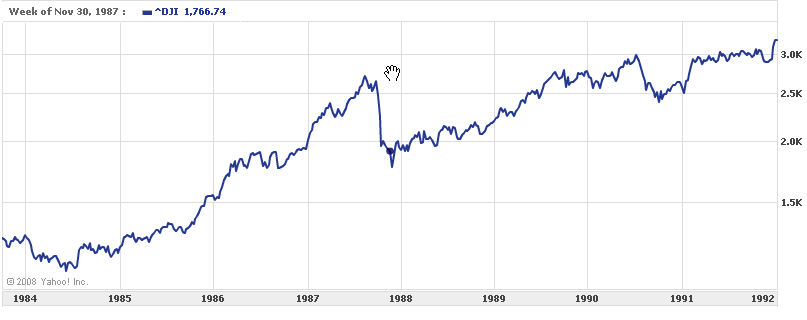
1. Good: The market enjoyed a relatively quick recovery after the 1987 crash, surpassing the 1987 peak by mid-1990. Could we be so lucky this time?

2. Bad: The Dow peaked near 1000 in 1966, and then went on a rollercoaster ride, never permanently crossing 1000 until 1983! That’s an effectively flat market for 17 years.

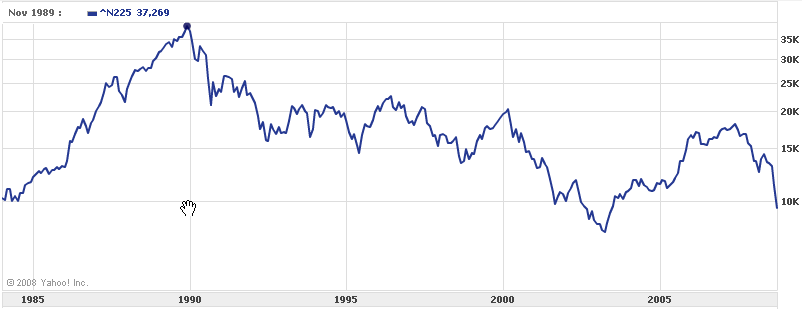
3. Ugly: Japan’s phenomenal postwar growth and an associated bubble peaked with the Nikkei index above 37,000 in 1989. The Nikkei subsequently crashed, and is now trading at the same levels as in 1983, 25 years ago! If this sounds impossible, consider that Japan’s bubble was fueled by reckless lending and a real estate bubble, and that Japan resorted to fiscal stimulus and banking system intervention not dissimilar to the global approach today.

While no one can be certain, I think the middle scenario is not unlikely. Given that the current bear market is now dated to have begun 8 years ago, with the dot com bust, we may still have another decade to go.

How Large is the Real Federal Deficit?

Politicians have a habit of trying to obfuscate facts that don’t paint a positive picture.  Thus when uncomfortable discussions on the federal deficit cannot be avoided, attempts are made to conceal its true size.  For instance, the Iraq war has been funded through emergency supplemental spending, leaving it outside the official federal budget and deficit numbers, though the spending is quite real.

A simple technique can be used to reveal the true* size of the annual Federal deficit. Since all federal revenue shortfalls (deficits) are paid for through increases in the total US debt, the increase in debt each year exactly equals that year’s real federal deficit.

Here is the amount of US Federal debt outstanding from 1997-2008, for Sept. 30th of each year:

Year US Debt ($ Billions)
2008 10,024
2007 9,007
2006 8,506
2005 7,932
2004 7,379
2003 6,783
2002 6,228
2001 5,807
2000 5,674
1999 5,656
1998 5,526
1997 5,413

Using this data, we can calculate the true Federal deficit for each year, and compare it to the publicly announced deficit for that year:

Year Official US Surplus / Deficit ($Billions) Actual US Deficit
($Billions, based on actual borrowing)
% Larger than Official
2008 -410 -1017 115%
2007 -162 -501 209%
2006 -248 -574 131%
2005 -318 -553 74%
2004 -412 -596 45%
2003 -377 -555 47%
2002 -158 -421 166%
2001 128 -133 204%
2000 236 -18 108%
1999 125 -130 204%
1998 69 -113 263%

The Federal government’s need to borrow has been consistently understated in official deficits for the past decade, and has been as large as triple the official number! These numbers also show that the US government never actually ran a surplus at any time in the last decade. It appears that the first step to dealing with our government’s revenue shortfalls is to get our government to admit how large they are!

* Under US GAAP, federal deficits would be even larger, because they would take into account future Social Security and Medicare shortfalls. These programs are likely to be modified in the future, however, and so I believe that the method used above provides an accurate measure of the government’s cash deficit each year. This is a number most Americans would recognize – how much do you have to borrow to pay the bills each year?

** The argument might be made that during the “surplus” years of the late 90s, debt was increased simply to provide liquidity in treasury bond markets. This doesn’t make sense, however – if it had a cash surplus, the Treasury could easily have issued new debt while retiring old debt, leaving net debt unchanged. Economists generally take the view that government debt crowds out private sector borrowing, so why would the Treasury borrow if it didn’t need the funds?

We Need a Good Recession

“I believe if the credit markets are not functioning, that jobs will be lost, that our credit rate will rise, more houses will be foreclosed upon, GDP will contract, that the economy will just not be able to recover in a normal, healthy way.”Ben Bernanke, Fed Chairman, Sept. 23rd, 2008

“that our American economy’s arteries, our financial system, is clogged and if we don’t act the patient will surely suffer a heart attack — maybe next week, maybe in six months, but it will happen.”Hank Paulson, Secretary of the Treasury, Sept. 23rd, 2008

Even before testimony concluded yesterday on Capitol Hill, reports with headlines like “Bernanke: Recession Certain in Absence of Bailout” and “Bush Administration Tells Congress to Act Quickly or Risk Recession” hit the wire services. Both Ben Bernanke and Hank Paulson stated clearly that a recession would occur if the proposed $700 Billion dollar bailout plan were not enacted. Similar threats of recession were used earlier this year when President Bush and Congress enacted a tax rebate stimulus program.

Let me ask a simple question: why is everyone so afraid of a recession? Recessions and boom times are both natural parts of the business cycle in market economies, and the United States experienced twenty recessions (including the Great Depression) in the 20th century alone. Economic downturns, with the associated bankruptcies and layoffs, help trim inefficient investments made at the peak of economic cycles, thus paving the way for the next round of economic growth.

The alternative to business cycles can be found in state-controlled economies, where inability to reallocate capital to new enterprises slows overall economic growth dramatically. Governments presiding over market economies also attempt to tamper with business cycles, and while intervention may soften the landing in a recession, it may also delay the recovery. Japan’s “lost decade” of the 90’s, where poor economic growth was the norm, resulted after Japan’s incredible economic boom of the 80’s. The extraordinary length of Japan’s recovery stemmed partly from the Japanese government’s inability to allow corporate and bank bankruptcies progress at the rate needed to clear out bad loans and start a new economic cycle.

The US would do well to heed Japan’s allegory. Ideally, any intervention in the financial markets should enable orderly collapse and restructuring of businesses overridden with bad debt. No one gains in a financial panic, but an unwinding of the excesses of the US housing bubble is inevitable. Creative Destruction is at the heart of the business cycle, it’s at the heart of the American economy, and it will be necessary in this cycle as well. Let’s not make it take longer than necessary.

Mortgages and Health Insurance: The Biggest Subsidies of Them All

Economists decry government subsidies, because they distort the market and cause inefficiencies, thus wasting taxpayers’ money and decreasing overall economic growth. Taxpayers and advocacy groups rightly decry government subsidies to corporations as pork-barrel spending.

Where then is the indignation regarding the two biggest subsidy programs of them all?

I’m talking about the home mortgage interest deduction and the employer health insurance deduction. The home mortgage interest deduction subsidizes homeowners at the rate of $100 billion per year, while employer health insurance is similarly subsidized at $250 billion per year. These subsidies carve a large hole in government revenue, which could otherwise be used to reduce the deficit or reduce taxes for everyone.

Both subsidies also have a more insidious effect – they raise prices for both homes and medical care, thereby making it harder for those with low incomes to afford either one. The mortgage deduction lowers the effective cost of a house for all buyers, thus increasing demand and raising prices. The net effect of the subsidy is to cause Americans to live in bigger houses than they otherwise would, without raising rates of home ownership significantly. Similarly, the employee health care deduction raises the cost of health care for everyone, and causes Americans to spend more on health care than they otherwise would.

Neither deduction is designed to help those with the greatest difficulty in getting a home or health insurance. Lower income families can’t afford the down payment required to avail themselves of the mortgage tax break, and most low-paying jobs don’t provide health care as a benefit.

These subsidies are popular because they target middle and upper-income America, but that doesn’t make them any more effective than much-maligned corporate subsidies. $350 Billion is a lot of money, and should either be given back to ALL American taxpayers, or spent paying for the deficit, recent wars, or other priorities.

What People Make III: Career ROI is as important as salary

What is the purpose of higher education? While a minority of college students have enough wealth to study as a hobby, college students generally view college as a step towards a career, with higher earnings potential as one motivation. But while a four-year college education generally has the same price tag regardless of degree, an individual’s future earnings potential vary widely depending on the degree chosen. Here is a partial ranking of careers, ranked by NPV and rate of return (details on the methodology at bottom):

Career ROI Rankings:

Career Average Salary NPV After-tax earnings (lifetime) Rate of Return
1. Law $124,230 $188,000 $4,825,000 15%
Attorneys rank high on the list since their education is complete just three years after college, and they can step right into six-figure salaries.
2. Computer Science $83,160 $184,000 $3,534,000 19%
Computer science grads start work immediately after college with salaries above 50k, giving them the fastest payback on their investment. Lifetime earnings potential is lower than in some professional fields, however.
3. Pharmacy $98,960 $168,000 $3,885,000 16.2%
Pharmacists typically must complete a six year program before starting work, but high demand for pharmacists enables them to move directly into $90k per year positions upon graduation.
4. Medicine $179,000 $151,000 $5,908,000 12.9%
Doctors have always enjoyed good incomes, but their educational investment is so high that it reduces their educational ROI more than is commonly realized.
5. Accounting $69,500 $148,600 $3,151,000 17.9%
Accountants can start work right after college, and their pay increases considerably once they’ve completed their CPA certification.
6. Airline Pilot $148,410 $125,000 $3,578,000 14.25%
Airline pilots must work for years at low paying regional air or charter jobs before making it to a major carrier, but the final payoff is a relatively high salary and reasonable working hours.
7. Nursing (RN) $62,480 $100,000 $2,633,000 16.3%
Nurses can finish training in as little as three years, and earn relatively good salaries right from the start, with job prospects virtually anywhere in the country.
8. Architecture $73,650 $54,000 $2,839,000 12.3%
Architects have decent salaries in the long run, but they must first complete a five year Bachelor’s program, and then spend several years as interns before becoming full-fledged architects.
9. Graphic Design $45,340 $24,850 $2,125,000 11.6%
Graphic Designers can start work right after finishing college, but competition for positions is high, keeping salaries down.
10. Teaching (K-12) $52,450 -$10,100 $1,986,000 9.4%
Teachers are not particularly well compensated in the US, and since their starting salaries are particularly low, the NPV of an investment in a teaching career is actually negative.
11. English (PhD) $60,000 -$14,000 $2,301,000 9.3%
At the bottom of the rankings are Humanities majors. If an English or Humanities PhD candidate tells you that they didn’t go into it for the money, they’re not lying: this career path has a negative return on investment in income terms.

Annotated spreadsheet with all calculations: HTML | XLS with formulas

Law, Computer Science, and Pharmacy majors take top honors in terms of career ROI, while (perhaps not surprisingly) artists, teachers, and Humanities professors come out on bottom. Doctors and airline pilots are further down the list than one might suspect, principally because they spend so many years in training before achieving high compensation.

Definition of Terms:

NPV: This is the Net Present Value of the student’s investment in education, based on a 10% discount rate. 10% is a common rate of return expected for long-term investments, and it helps provides a fair benchmark of the value of each career path.

IRR: This is the Internal Rate of Return of the educational investment. IRR tends to favor shorter time horizons, so shorter educational paths like computer science are rewarded when measured via IRR.

Lifetime Earnings: This is a simple sum of the lifetime after-tax earnings of each career path from age 18 through age 65.

More info on Methodology:

All salary data was taken from the BLS May 2007 Occupation Employment and Wages Estimates. College was assumed to cost $20,000 per year (this sounds low, but is an average for public and private colleges, after all scholarships, grants, and student work are taken into account). Professional school costs, and graduate and resident stipend data were sourced variously, and are noted in the spreadsheet. Inflation at 2% and progressive taxation were also accounted for in the calculations.

The rate of return for each field was calculated by determining the IRR for each field, taking into account the cost of college and measuring total after-tax gains from age 22 to age 65. The NPV of each career path was also calculated with a discount rate of 10%. Finally, lifetime after-tax earnings were calculated as a simple sum to provide another measure of earnings potential.