Electric vs Gasoline – Which is more cost effective?

Last summer gas prices spiked and the media was awash in stories about the electric car, whether from major automakers or startups. Just a few months later, gasoline is at $1.50 and SUV sales have begun to rise again. Environmental and foreign policy benefits notwithstanding, electric vehicles are perceived to be more expensive than gasoline vehicles. At what gasoline price are electric vehicles more cost effective?

In Theory, Electric Vehicles are More Efficient

Electric motors are very efficient, converting over 90% of electrical power supplied into motion, while gasoline engines manage only 20% efficiency. On a full life cycle basis including power plants and oil wells, electric vehicles manage about 34% efficiency versus only 14% for gasoline vehicles [1]. In theory electric vehicles are much more efficient.

But how does it work in practice? Let’s take a look at two real-world examples, the Tesla electric sports car, and the Hymotion plugin-hybrid modification for the Toyota Prius.

Hymotion Toyota Prius and Tesla Examples

Hymotion is now selling a plugin hybrid modification for the Toyota Prius which enables it to travel roughly 40 miles with minimal gasoline usage. Hymotion states that independent testers have verified the Hymotion-modified Prius capable of receiving a 150mpg EPA city rating.

The Hymotion modification uses 5 Kwh of electricity, worth about 50 cents, to help power it through a 40 mile trip, while using the gas engine about 20% of the time. At $1.50 a gallon the total fuel cost for a 40 mile trip is about 30 cents, resulting in a total trip cost of 80 cents. The average American vehicle gets 20 mpg, so it would use 2 gallons for the trip, or $3.

Tesla provides a good life cycle energy usage comparison between its electric sports car and other automobiles on its website. The Tesla uses 177 watt-hours of energy per mile traveled, which costs 1.7 cents on average. Based on Tesla’s numbers, a 40 mile trip would cost 68 cents in a Tesla versus $3 for gasoline in a typical vehicle.

Even at $1.50 gas or $1 gas, electric and plugin-hybrid vehicles are significantly cheaper to operate than gasoline vehicles. But electric and hybrid vehicles are significantly more expensive than comparable gasoline vehicles today, which motivates the primary question:

At What Gasoline Price are Hybrid or Electric Vehicles Competitive?

For the Hymotion-modified Toyota Prius, the breakeven price of gas is around $3 a gallon. The Hymotion modification for the Toyota Prius costs $10,000, and the Prius itself costs roughly $5000 more than a similar non-hybrid vehicle. At $3 a gallon, a driver that drives 12,000 miles per year would save about $1500 per year, just recouping his initial investment over a 10 year timeframe.

Batteries represent the primary factor in the additional cost of hybrid vehicles, and battery price-performance is improving at a rate of about 8% per year. At this rate, the breakeven price will probably be $2 a gallon in 2013.

Plugin hybrids and electric vehicles provide one additional savings: time. The average driver fills up almost every week, losing a total of 8 hours a year. For busy professionals, 8 hours of time could be worth $500 to $1000 or more, making plugin-hybrids the cost-effective choice today!

Footnotes:

[1] Electrical energy is created by burning fossil fuels in a power plant at 40% efficiency, followed by transmitting it to your house at 93% efficiency, and using it in an electric vehicle at 92% efficiency, providing a total efficiency of around 34% for an electric vehicle. Crude oil refineries operate at 75% efficiency, and gasoline distribution might cause another 6% energy loss. Since internal combustion engines are only 20% efficient, total efficiency would be around 14%. Assuming that the natural gas and oil to power our vehicles comes from the same well, we can directly compare these efficiencies, and thus conclude that electric vehicles are significantly more efficient.

Stimulus Plan Ideas

I’ve been thinking about President-elect Obama’s proposed stimulus plan lately, as it represents one of the larger policy decisions of the coming year. Most economists agree government stimulus that some form of is necessary to prevent a deflationary economic environment, and to improve economic sentiment. But what criteria should we use to judge fiscal stimulus spending, and are there any good ideas out there that haven’t been considered?

Stimulus Plan Criteria:

1. Speed: Any stimulus spending needs to occur quickly in order to boost the economy. Projects which don’t hit the ground til 2010 don’t meet this criteria.

2. Spent, Not Saved: Ideally, 100% of any stimulus funds should be spent on consumption of goods and services to kick-start the economy. Tax rebate checks, particularly to the wealthy, perform poorly in this regard because a larger percentage of the funds will be saved.

3. Return on Investment: Projects with a measurable return on investment, whether in economic growth or otherwise, are preferable to spending that has no longer term benefit.

With these criteria in mind, here are some fresh ideas that I think deserve consideration:

1. Convert school buses and bus fleets to CNG. This would decrease diesel emissions near children, and also reduce US dependence on foreign oil, while providing an immediate boost to the auto manufacturing sector. Particulate pollution kills tens of thousands of people annually – why not spend to improve public health and reduce oil dependence at the same time? $25 Billion would enable the conversion of half the nation’s school bus fleet.

2. 100% tax credits for energy efficiency in homes and small businesses. Instead of handing out tax rebate checks, which aren’t spent in full, why not pay homeowners and businesses to improve energy efficiency? President-elect Obama has made a similar proposal regarding federal buildings, but tax credits would lead to faster spending since consumer and small businesses can move more quickly. $50 Billion would retrofit 50 million of America’s single family homes with energy saving modifications.

3. Increase funding for basic science research. The great economic booms of the 80’s and 90’s were driven by technological advances like the personal computer, the internet, and pharmaceutical technology, and these technologies had their early beginnings in basic research. Increasing basic research and grant expenditure at the NSF, NIH, DARPA, and other agencies would employ thousands of new college graduates and researchers while accelerating the path to future technological breakthroughs. Doubling the NSF and DARPA budgets would cost $10 Billion, while another $5 Billion would add to NIH’s budget.

Funding these ideas in total would cost $90 Billion. While federal spending at this level would crowd at private investment in normal circumstances, today’s circumstances have drastically reduced private investment across the board. If the Federal government is planning to spend close to a trillion dollars on stimulus, shouldn’t we fund high return projects like these?

What’s the Real Federal Deficit?

The federal deficit for the past ten weeks alone is now 650 Billion dollars, in addition to a fiscal 2008 deficit of $1 Trillion.

Since the US government fiscal year ended on 9/30/08, the federal debt has increased from $10,024 Billion to $10,656 Billion (as of 12/9/08).* The federal debt increased by $1 Trillion over the 12 months ending 9/30/08.

As I’ve previously noted, measuring the Federal deficit by looking at growth in the Federal debt provides a clearer picture of budget shortfalls than the officially announced numbers, which hide significant expenditures, and paint too rosy a picture.

A large part of the recent increase in the debt can be tied to the Treasury Department’s various stabilization and bailout initiatives, including the TARP and other programs. President-elect Obama plans to add a significant dose of fiscal stimulus to the Treasury and Federal Reserve efforts, driving the deficit up by another 500 Billion to one trillion in the next year. While current circumstances do call for aggressive action, the government should take care not to exacerbate our economic problems by trying to roll the clock back to 2006. Lowering mortgage rates for new home purchases, for instance, provides an incentive to create and buy more of a product that is already in a state of massive over-supply.

When the bad times end, we’ll have to start paying these debts back. Let’s hope President-elect Obama and his team spend their stimulus money on projects with tangible return on investment, and not just on make-work programs.


* A significant portion of the increase in deficit spending is being used to buy financial institution shares and various commercial debt instruments, which might be thought of as investments. Nonetheless, the federal debt grows when we borrow, even if we use the money to buy investments. This holds true for personal balance sheets, corporate balance sheets, and for the federal government as well. The federal government has a particularly poor record of decreasing the size of its debt, so I believe it’s fair to regard any excess borrowing as a deficit.

Level the Playing Field for Mass Transit

President-elect Barack Obama announced a massive public works program this weekend to rebuild America’s infrastructure, with investments in transportation, energy efficiency, and schools planned.

Obama could further his fiscal stimulus and infrastructure program by leveling the playing field between road and mass transit investments. When the Interstate highway system was created, the federal government provided 90% of the financing, requiring states to pitch in the remaining 10%. In contrast, most transit projects in the US received little or no federal funding until the 70’s, and currently receive 60-80% in federal financing. In addition, transit projects have to meet steep qualification requirements before being funded, while states are provided lump sum funding for road projects which can be used with much greater discretion.

Why not level the playing field by allowing states to use federal transportation funding as they see fit, without explicitly allocating it for roads or mass transit? States with large urban areas could then focus on large-scale transit projects, while rural states could focus on traditional road construction. This blog has consistently advocated against subsidies of all kinds, but since most major transportation projects are funded via the DOT, it makes sense to enable states to spend the money according to their needs.

In the current economic environment, fiscal stimulus is advisable, and fully funding mass transit projects will help advance the new administration’s energy policy as well. Providing equal funding for both mass transit and roads should be an easy win for the Obama administration, and I hope that the new President takes this step.

What’s the Real Unemployment Rate?

The U-5 measure of unemployment stands at 7.5% in October 2008.

The officially reported unemployment rate rose to 6.5% in October 2008, according to the US Bureau of Labor Statistics. The BLS actually collects 6 different measures of unemployment, however, and reports U-3, one of the middle-range measures, as the official unemployment rate. This rate includes those who are actively looking for work, but does not include those who have given up looking because they can’t find a job. The official unemployment rate also excludes those who are working part-time but can’t find a full time job.

So what are the numbers?

October 2008 Unemployment Measures

U-3, Officially Reported Unemployment: 6.5%
U-5, Unemployment Rate including those who have given up: 7.5%
U-6, Unemployment Rate including under-employed: 11.8%

Since most Americans count those who have are discouraged to look for work as unemployed, the U-5 measure is a more accurate measure of unemployment, even if it’s less politically palatable. One percent of the US work force equates to 1.5 million people. So next time you see the headlines, remember to add a percentage point (or two!) when looking at unemployment numbers.

Do Lower Gas Prices Counteract Higher Unemployment?

Gas prices have fallen below $2 a gallon here in Atlanta, and in many other parts of the country. Unemployment is heading in the opposite direction, up to 6.5% at last count. With gas prices dropping so rapidly from $4, how much cushion will this provide for the economy?

The average price of regular gas over the last twelve months was $3.41, and Americans drove roughly 3 trillion miles over that period. If gas averages $2 over the next 12 months, Americans could save $211 Billion on gasoline over the next year, a savings of around $2000 per family.

How does this compare with the economic impact of lost employment? A 1% rise in unemployment corresponds to roughly 1.5 million jobs lost, and $75 Billion in total income lost at average American salaries. If unemployment rises from 5% (early 2008) to 8%, then the $225 Billion in lost wages may have approximately the same size impact in economic terms as the decrease in gasoline prices.

That’s a surprising result – gasoline is so important to the US economy that the drop in price negates a 3% drop in employment! While that won’t solve the problem of global de-leveraging and the credit crunch, it’s a big cushion to lean on.

Sources and Calculations:

US Total Vehicle Miles: http://www.fhwa.dot.gov/ohim/tvtw/tvtpage.cfm

US Gasoline Prices: http://www.eia.doe.gov/oil_gas/petroleum/data_publications/wrgp/mogas_history.html

US Unemployment Stats: http://www.bls.gov/news.release/empsit.nr0.htm

US Total Wage Stats: Bureau of Economic Analysis

Gas Price Savings Calculation: 3 trillion miles / 20 mpg = 150 Billion gallons. 150B gals * 1.41 = $211B. The gas price was measured using the last 12 months to Oct. 31, 2008, from the EIA data above. If there are 100 million families in the US, this equates to roughly $2000 per family. Alternately, if the average family has two cars, and drives a total of 25,000 miles per year, then this equals 1250 gallons, and a savings of $1760.

Lost Wages Calculation: From the BLS, there are 154 million people in the labor force, so 1% rise in unemployment = 1.5M additional unemployed. From the BEA report, total US wages are 8 Trillion, or roughly $50,000 per person. 50,000 * 4.5M = $225 Billion

In comparing the magnitude of the two, both the drop in employment and drop in gasoline prices have multiplier effects on the economy that aren’t measured here. This raw comparison accounts for the first-order effects of both changes on the economy.

US Healthcare Reform: Possible Choices

The United States’ health care system is a patchwork of private care, Medicare for seniors, Medicaid for some of the poor, and emergency-only care for the 47M uninsured. Both presidential candidates insist that change is needed, with increased coverage and decreased costs as primary goals. Neither candidate mentions how public dollars will be rationed, though government resources are limited.

Here’s a list of a range of health care systems in place around the world, with the most market-oriented systems listed first, and the most government controlled systems listed last. The future of American health care will mostly take the form of one of the middle options, as both extremes appear politically unpalatable.

US Health Care System Choices:

Health Care System Description Found Where
Traditional Free Market Little government intervention, patients pay health care providers directly. Those without financial means rely on charity hospitals or receive no care. India, many developing countries
Public Senior Care + Semi-Free Market The government provides health care for seniors, while others rely on a regulated private health insurance market (whether purchased individually or through an employer). United States
Public Care for Children and Seniors The government provides health care for seniors and children, while others rely primarily on the private health insurance market (whether purchased individually or through an employer). Barack Obama’s health care plan approximates this
Mandatory Health Insurance The government requires that all individuals purchase health insurance, and provides subsidies to assist the poor and unhealthy in purchasing coverage. Massachusetts, Hillary Clinton’s Plan
Dual Public-Private System The government provides health care for all residents not enrolled in private care, and provides incentives for employers to provide health care and for individuals to purchase care. Individuals may also pay extra to supplement their basic government plan. Australia
Single Payer, Private Premium Care The government provides health care for all residents, and individuals can choose to pay extra for premium health care services (like private rooms, experimental treatments, etc). France, other European countries
Single Payer Only The government pays for all health care, and does not allow private market health care transactions. Canada

Why does America encourage debt?

America (and the world!) is now being punished for its relentless accumulation of debt during the housing bubble and before. Commentators of all stripes have laid blame for the credit bubble, whether upon Alan Greenspan, lack of regulation, greedy Wall Street, or otherwise.

But it’s interesting to note that US credit bubble has in fact been building for decades, as shown here:

US Household Debt to GDP Ratio

I have a basic question: Why does America encourage debt? Both individual and corporate debt are encouraged through federal and state law, through mortgage interest deductions for individuals, and through similar deductions on interest payments by corporations.

The home mortgage deduction is a relatively recent invention, while business interest has been deductible since the advent of the income tax. Both deductions encourage us to borrow and increase leverage – and as we know now, leverage cuts both ways. The home mortgage deduction raises home prices and encourages Americans to take on excess debt. But what about the business interest deduction?

Businesses can typically raise money by either borrowing it or by selling equity in their business. Since borrowing is subsidized through a tax deduction, this encourages businesses to borrow money rather than selling shares to raise money. The downside is apparent in hard times: creditors demand repayment, whereas equity investors share in both gains AND losses*.

The home mortgage and business interest deductions formed the foundation of the credit bubble by creating a tax benefit for borrowing rather than saving.

These deductions also collectively cost taxpayers $250 Billion** per year, more than the Iraq war and almost as much as Medicare. Perhaps the next Administration should consider restoring the balance of incentives between saving and borrowing as part of its tax reform initiatives. While an immediate end to these preferences is impractical, a phased reduction coupled with broad-based tax relief might help transform America back into a nation of savers.

*From a business perspective, interest has always been treated as just another business expense, and is thus deductible just like the electric bill. But debt and equity are often competing forms of ownership in a business, and so making interest deductible makes debt more appealing than issuing shares. For example, a a pizza shop could borrow $10,000 for a renovation and deduct the interest as a business expense, or it could bring in a partner to buy 10% of the business in order to raise capital. If the owner of the pizza shop brings in a partner, he doesn’t get a deduction, and now he has to share any additional income with his partner. Thus debt is favored over equity – this principal is even taught in business schools.

** The home mortgage deduction costs totals $100 Billion per year, while the business interest tax deduction can be estimated at $150 Billion per year with total corporate debt of $10 Trillion, an average interest rate of 5% (conservative estimate), and a corporate tax rate of 33%.

Crash of 2008: Three Potential Scenarios

The Financial Panic and subsequent stock market Crash of 2008 are now a boldface reality. So where do markets go from here? Here are three scenarios that we might confront:

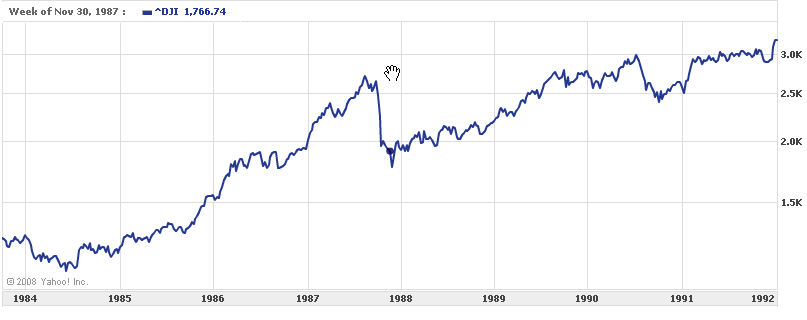
1. Good: The market enjoyed a relatively quick recovery after the 1987 crash, surpassing the 1987 peak by mid-1990. Could we be so lucky this time?

2. Bad: The Dow peaked near 1000 in 1966, and then went on a rollercoaster ride, never permanently crossing 1000 until 1983! That’s an effectively flat market for 17 years.

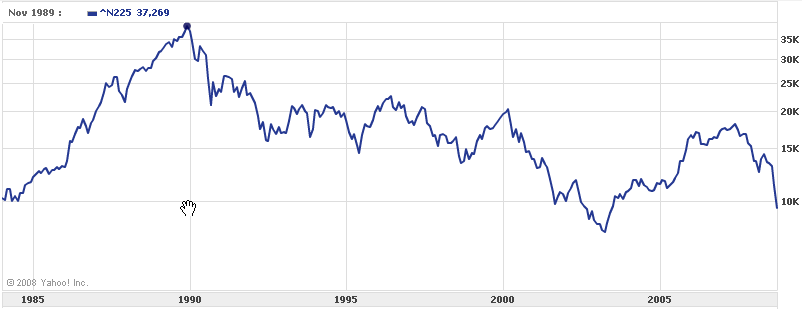
3. Ugly: Japan’s phenomenal postwar growth and an associated bubble peaked with the Nikkei index above 37,000 in 1989. The Nikkei subsequently crashed, and is now trading at the same levels as in 1983, 25 years ago! If this sounds impossible, consider that Japan’s bubble was fueled by reckless lending and a real estate bubble, and that Japan resorted to fiscal stimulus and banking system intervention not dissimilar to the global approach today.

While no one can be certain, I think the middle scenario is not unlikely. Given that the current bear market is now dated to have begun 8 years ago, with the dot com bust, we may still have another decade to go.

How Large is the Real Federal Deficit?

Politicians have a habit of trying to obfuscate facts that don’t paint a positive picture.  Thus when uncomfortable discussions on the federal deficit cannot be avoided, attempts are made to conceal its true size.  For instance, the Iraq war has been funded through emergency supplemental spending, leaving it outside the official federal budget and deficit numbers, though the spending is quite real.

A simple technique can be used to reveal the true* size of the annual Federal deficit. Since all federal revenue shortfalls (deficits) are paid for through increases in the total US debt, the increase in debt each year exactly equals that year’s real federal deficit.

Here is the amount of US Federal debt outstanding from 1997-2008, for Sept. 30th of each year:

Year US Debt ($ Billions)
2008 10,024
2007 9,007
2006 8,506
2005 7,932
2004 7,379
2003 6,783
2002 6,228
2001 5,807
2000 5,674
1999 5,656
1998 5,526
1997 5,413

Using this data, we can calculate the true Federal deficit for each year, and compare it to the publicly announced deficit for that year:

Year Official US Surplus / Deficit ($Billions) Actual US Deficit
($Billions, based on actual borrowing)
% Larger than Official
2008 -410 -1017 115%
2007 -162 -501 209%
2006 -248 -574 131%
2005 -318 -553 74%
2004 -412 -596 45%
2003 -377 -555 47%
2002 -158 -421 166%
2001 128 -133 204%
2000 236 -18 108%
1999 125 -130 204%
1998 69 -113 263%

The Federal government’s need to borrow has been consistently understated in official deficits for the past decade, and has been as large as triple the official number! These numbers also show that the US government never actually ran a surplus at any time in the last decade. It appears that the first step to dealing with our government’s revenue shortfalls is to get our government to admit how large they are!

* Under US GAAP, federal deficits would be even larger, because they would take into account future Social Security and Medicare shortfalls. These programs are likely to be modified in the future, however, and so I believe that the method used above provides an accurate measure of the government’s cash deficit each year. This is a number most Americans would recognize – how much do you have to borrow to pay the bills each year?

** The argument might be made that during the “surplus” years of the late 90s, debt was increased simply to provide liquidity in treasury bond markets. This doesn’t make sense, however – if it had a cash surplus, the Treasury could easily have issued new debt while retiring old debt, leaving net debt unchanged. Economists generally take the view that government debt crowds out private sector borrowing, so why would the Treasury borrow if it didn’t need the funds?