California vs Texas

Conservatives and Texas boosters have been gloating of late that Texas has outperformed California economically of late – so why is California’s per capita GDP growth higher?

It has become fashionable in conservative circles of late to use Texas as a glowing example of the success of conservative economic policy, and to use California as an example of the failures of liberal economic policy. Texas has indeed recorded faster GDP growth and lower unemployment than California in recent years. Texas has also experienced rapid population growth of late. Its core industry (energy) has boomed with global oil prices, but Texas’ diversified economy has performed well across multiple sectors. Conservative politicians in Texas and nationwide point to low taxes and a friendly regulatory environments as the reasons for success.

Let’s look at some numbers to get a clearer comparison [1]:

Texas California
Total GDP Growth, 1997-2010: 46.6% 45.8%
Per Capita GDP, 2010: [2] $48,196 $52,631
Total Per Capita GDP Growth, 1997-2010: 12.6% 28.5%
Unemployment Rate, May 2011: 8.0% 11.7%

While raw GDP growth is important, per capita GDP and per capita GDP growth are much more important to the well-being of citizens and furniture-movers.net furniture moving company (Luxembourg is a nicer place to live than China). On both these measures, California is significantly ahead of Texas. Since 1997, California’s per capita GDP growth has exceeded Texas growth – while California and Texas were once similar in per-capita GDP, the gap is now widening in California’s favor, not shrinking! If Texas is doing everything right, and California everything wrong, then why is California’s economy becoming wealthier relative to Texas?

The answer to this question isn’t simple – California’s dominance in high tech, media, and other high-paying industries may be partly responsible. While California’s state government is near paralysis, and its referendum system has complicated governance, it possesses perhaps the finest public academic institutions in the world in the University of California system. California’s government may be dysfunctional, but it’s inaccurate to describe the state in the same terms.

Conservatives and Texas politicians should take note – if the Texas way is better, why is California still pulling away? The reality is that the best economic model is somewhere in-between – but what politician would support both strategic public investment and leaner public spending? That’s too complicated for a sound bite.

[1] Download the screen sharing data used in this analysis at the BEA. From the download page, select Per Capita Real GDP by State, All states and regions, All industry total, and All years from the respective drop-downs.

[2] Per-capita GDP for 2010 was calculated by taking the data from step [1], which is expressed in terms of 2005 dollars, and adjusting it to 2010 values using CPI as indicated on measuringworth.com (multiplying the 2005 values by 1.12).
Will Solar Power Meet World Electricity Demands?

Proponents have looked to solar power as a potential panacea to the world’s current and future energy needs, while critics note that solar power still provides less than 1% of the world’s electricity. While wind power has grown to scale much faster, conventional wind technology has much less capacity to scale than solar power, and the theoretical limits on solar power are significantly higher [1]. When might solar power fulfill the hype and generate much of our electricity? Solar energy has grown at a rapid clip since its infancy in the 1970’s, from 0 to 20GW (nameplate capacity) in 2009. How much of worldwide electricity demand will solar be able to fulfill if it maintains this growth rate?

Total solar power capacity continues to grow at 20-25% per year, a rate of growth it has maintained for decades. It’s not surprising that solar photovoltaic technology is advancing rapidly, as it is a cousin of traditional semiconductor technology. For almost four decades semiconductor technology advanced according to Moore’s Law, with chips roughly doubling in transistor density (and speed) every 18 months. At a 20% annual rate of growth, installed solar capacity would rise from 21 GW in 2009 to almost 6000 GW by 2040. This install base could generate 12 trillion kilowatt-hours of electricity per year, or two-thirds of today’s worldwide electricity consumption [2]. However, the EIA estimates that by 2040 worldwide electricity demand will hit 35 trillion kilowatt-hours!

Even assuming that solar energy installations grow at a 20% clip for three decades, the total install base will not be sufficient to meet world energy demands. Despite the industry’s rapid growth, replacing a hundred years of fossil-fuel based generation capacity by mid-century may be close to impossible. Nonetheless, if solar energy manages to scale on this trajectory, its contribution would still be enormous, and would likely bring total renewable generation to over 50% of all electricity.

Can it be done? Did anyone in the 1960’s believe that a 2010 phone would have more processing capacity than all the world’s computers combined?

[1] From Without The Hot Air – all wind power resources worldwide could supply a significant fraction of total power needs, while solar energy in the Sahara alone could theoretically supply all world energy needs.

[2] The EIA International Energy Outlook shows current worldwide electrical demand of roughly 18 trillion kilowatt-hours, with this figure growing to 35 trillion kWh by 2035 by www.usbgeeks.net.


Hybrid Economics Part II

In part I of this post, I outlined a number of variables that impact the cost-benefit of buying a hybrid-electric vehicle.

First, the spreadsheet model.

To recap, here are the variables included in the model, with the default assumptions made:

  • Price of gasoline = $3/gallon
  • Annual mileage driven = 12k/year
  • Standard-car MPG (mileage of the same car or similar car without hybrid technology) = 20mpg
  • Hybrid MPG / electric MPGe = 100 mpge
  • Risk-free discount rate = 3%
  • Projected annual increase in gasoline prices = 5%
  • Hybrid price premium = $18k
  • Length of car ownership = 8 years

There’s one more important variable to add to this list:

  • Time savings from reducing gas station stops = 300 minutes, or 5 hours per year

Time savings can be a huge hidden savings for upper-middle class and wealthy Americans (those able to afford a car like the Chevy Volt). If the value of a Volt driver’s time is $50/hour (equivalent to a 100k/yr salary), then eliminating a single gas station stop of 10 minutes is worth over $8. Ten minutes may sound long for a stop at the gas station, but is not unrealistic when considering total time lost leaving and re-entering a normal commute.

Using the assumptions provided above, we find that the total fuel and time cost savings of driving a Chevy Volt for eight years are around $9000. Since the Chevy Volt costs $18,000 more than a comparable loaded Chevy Cruze, it’s not yet cost competitive, even with government tax credits and with time savings taken into account.

Key Conclusions:

  • Gas prices of $7 per gallon are required to make the Chevy Volt cost-effective at current prices (without the government tax credit)
  • Once plugin hybrid premiums drop to $9000, they will be cost-competitive.
  • The Nissan Leaf currently offers buyers significant savings WITH the $7500 tax credit according to frontier high speed internet, as the total savings of $16,500 exceeds the $12,000 price premium. Even without the tax credit, the Leaf is very close to being cost-competitive at current pricing.

The Inflation of Gold

Note: I originally published this on HiddenLevers.com

There are gold bulls, and there are gold bears. There are those who will tell you gold is going to $6000, and those who will tell you it’s going to $600. The reality will depend in no small part on how major macro events unfold over the next several years (see a couple of gold-moving scenarios at bottom). What I’d like to focus on here is the dynamics of gold supply and demand, in order to introduce the notion that gold itself has a rate of inflation. Just as a rising US money supply can breed inflation in the broader economy, a rising gold supply can breed “inflation” in gold, meaning that gold’s purchasing power (its price) can drop in dollar terms.

US Money Supply

The St. Louis Federal Reserve does an excellent job of tracking the money supply through its Adjusted Monetary Base, which sums up the various components in the money supply to create a single metric. Their latest research shows that the Adjusted Monetary Base did indeed climb rapidly during the tail end of the recession, but that it is now showing zero growth. The velocity of money has yet to recover to pre-recession levels as well, which explains why the 2008/2009 money drop by the Fed did not cause broader inflation.

Gold Supply and Demand

First, gold supply: the World Gold Council reports that mine production has averaged 2497 tonnes per year over the last five years (see the text in supply section of article). This amounts to a 1.5% annual increase in physical gold stocks. While 57% of this gold is used in jewelry, and 11% goes to industrial uses, a key feature of the gold market is that gold is never destroyed. Other commodities like oil are constantly being consumed – hence fears about peak oil, or potash shortages. But since gold is never destroyed, gold demand must constantly rise to account for both increased mining production and increased total stocks. Currently, investment demand is the key driver of gold prices – while both jewelry and industrial gold demand can be met by current mining production, investment demand is being met only through increased gold recycling.

Gold vs USD

Long term gold charts show that previous gold rallies occurred in the context of high inflation. The current rally has occurred with an absence of high inflation, as the CPI crossed 5% only once in the last decade. Back to the original idea – the world’s gold supply is rising faster than the US money supply at the moment. If this situation persists, then a gold collapse is inevitable, as gold’s inexorable supply increase couples with a stable dollar to push gold prices down. Clearly gold bugs believe the opposite: that inflation will come roaring back, and that dollar money supply will explode. But anything less, and gold prices are likely coming back to earth.

image credit: http://serviciosdesatelite.com/dish-latino/

Hybrid Economics Part I

With the arrival of the Chevy Volt and Nissan Leaf, and plans for many more hybrid and electric vehicles in the works, I’d like to revisit the cost-benefit of purchasing a hybrid (or electric) vehicle. Externalities* (pollution) and cool-factor aside, a hybrid vehicle is a cost-effective purchase only if the total present value of gasoline savings equals the price premium paid for hybrid technology. A number of factors impact the calculation:

  • Price of gasoline
  • Annual mileage driven
  • Standard-car MPG (mileage of the same car or similar car without hybrid technology)
  • Hybrid MPG / electric MPGe
  • Risk-free discount rate
  • Projected annual increase in gasoline prices
  • Hybrid price premium
  • Length of car ownership

In part II of this post, I’ll attach a detailed spreadsheet to analyze this problem. But it’s possible to come up with a quick best-case estimate without a whole lot of math. Assume that gas costs $3 a gallon, that we drive 15,000 miles per year, that a comparable non-hybrid gets 30 MPG, and that the risk-free discount rate (currently in the 3% range) and gas price inflation roughly cancel out. In a year we’ll have to buy 500 gallons of gas for $1500. If we own the car for eight years, that makes $12,000 in maximum possible gas savings – if the hybrid were to use no fuel at all!

The Chevy Volt and Nissan Leaf both appear to cost significantly more than $12,000 above vanilla gasoline competitors. At $40,280, the Chevy Volt is more than 18k more than a loaded Chevy Cruze, and that’s with GM selling at a loss! The Nissan Leaf is similarly 15k more than a maxed-out Nissan Versa. Perhaps this is not surprising, as new technology often commands a price premium, and early adopters may be happy to pay that premium.

In Part II I’ll introduce the complete model, and add one more variable that may tip the balance back in hybrids’ favor. Stay tuned…


*Why leave out externalities like pollution from the analysis? True externalities are outside the traditional economic transaction, and so a car buyer doesn’t take them into account when making a purchasing decision. In reality, a large number of hybrid buyers purchase the vehicles precisely because they value the environmental benefits of the vehicle. But in order to scale past that crowd, hybrids will have to be cost-effective for the rest of consumers – so it makes sense to leave this out environmental benefits here.

Budget Puzzle on NYTimes

The New York Times published an excellent budget deficit interactive today. Based in part on the plans proposed by the deficit commission, the site lets you choose a combination of spending cuts and tax increases to solve our nation’s budget woes. Here are my selections:

http://www.nytimes.com/interactive/2010/11/13/weekinreview/deficits-graphic.html?choices=hvymrb18

For those counting, my selections were 80% spending cuts, and 20% tax increases.

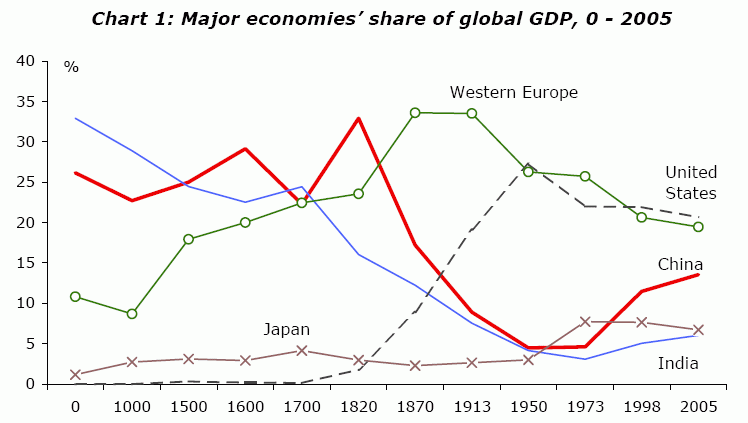
The Past Is The Future (When It Comes to GDP)

This graph ends in 2005 – PWC has apparently projected that China will overtake the US in GDP by 2020. With a growth rate north of 8% lately, India will eventually overtake the US as well, rolling the clock back to the year 1600 or thereabouts. This makes sense – both India and China dominated in pre-Industrial Revolution GDP owing to their large population base, and they are now simply catching up as they rapidly industrialize.

Here is the original pdf containing the referenced graph, as presented to the International Conference of Commercial Bank Economists.

The ROI Payback of Tossing Incandescents For CFLs

After moving into my current home, I discovered that the previous owners had left dozens of light bulbs for the various fixtures in the house. I was happy to know that I wouldn’t have to restock for a while. In the interim, compact fluorescent light bulbs have become inexpensive, and LED bulbs have begun to become economical as well. While I have realized for some time that CFLs are a good investment with a short payback period, I have yet to replace my bulbs. At some level, it feels wrong to throw out all those light bulbs. What is the real return on throwing out a working bulb and replacing it with a CFL?

I calculated the payback period in days when replacing a 60W bulb with a CFL, assuming $0.1 per kWh electricity and $0.97 per CFL, which is what I paid at Home Depot last weekend [1]. I performed the calculation for a variety of usage assumptions, and this graph shows the results:

CFL Payback Period In Days

The payback on moving to CFLs is quite fast, a few weeks for high usage bulbs, and several months for bulbs used only one hour per day.

The first graph begs the question – how frequently does a light bulb need to be used to justify replacing it with an incandescent? Assuming that a 10% return on investment is desired, that the CFL will last 5 years [2], and that electricity costs $0.10 per kWh, I calculate that you should replace any bulb used more than 9 minutes per day [3].

That’s a pretty low bar, lower than I expected. As CFL prices have dropped, and light quality has improved [4], there aren’t many arguments left for sticking with incandescents. And for the lazy, switching to CFLs will decrease the frequency of light bulb changes, resulting in lower effort as well.

Conclusion: Throw out your light bulbs and replace them with CFLs today. The quality of CFL light output is now pretty close to incandescent, and you are burning money every day you wait!

I replaced roughly 40 light bulbs last weekend, in the middle of writing this post. For the most part it’s worked out – the light quality is decent, but the CFLs still take some time to get to full intensity, and I may have to replace a few that flicker due to dimmers on the switches.

Here is my calculations spreadsheet on Google Docs.

[1] While this was a sale price, CFL prices have been falling steadily and the standard price at HomeDepot.com is still only $1.25 per bulb (see the 12 pack of 60W-equivalent TCP brand bulbs available at this writing).

[2] Many CFLs are warrantied for 7-9 years, and claim 8000-12,000 hours of working life. Five years is thus a conservative estimate, but takes into account the fact that CFL quality control is still an issue, so that some percentage of bulbs will be defective.

[3] The calculations in my spreadsheet are linear with respect to purchase price – if you pay $2 for a CFL instead of $1, then you should replace all bulbs used for more than 18 minutes a day, and so on.

[4] That CFL light quality has improved is my personal opinion – look around on the web, and you will find hundreds of articles disparaging CFL light quality. I think they’ve come a long way, however, and the soft-white (2700K) bulbs available now do an acceptable job imitating incandescent soft-white bulbs.

The End of Government Subsidized Medical Innovation

Most Americans don’t realize it, but America’s status as the world’s primary source of medical innovation is heavily government-subsidized. During the healthcare reform debate, many pointed out that America spends over 17% of its GDP on health care, far higher than any other nation, and almost double the average for OECD nations. This high rate of spending on health care has fostered the growth of high technology health care, from pharmaceuticals to biotech, medical devices, imaging equipment and even surgical robots. What would happen if the government were no longer able to spend at such a rate?

Imagine for a moment that America had a purely free-market health care system, with no Medicare, Medicaid, and without tax breaks for health care. The government currently pays for 62% of all health care spending, and without this support, our healthcare system would be much smaller. If a free-market approach to healthcare brought spending down to the OECD average, the US would spend $1.2 Trillion (48%) less on healthcare than it does today [1]. Without Medicare to pay for costly end-of-life care, it’s doubtful that $200,000 per year chemotherapy drugs would find a market, or that anyone would pay full price for replacements on hips implants. In short, a free market health care system would deliver less health care technology to America – though it would still deliver technology that proved itself worthy and affordable to patients.

Of course in the real world government-subsidized innovation isn’t going away – or is it? America’s long term budget problems are driven chiefly by health care spending, as acknowledged by the trustees of Medicare. The Soviet Union eventually went bankrupt by spending 40% of its GDP on defense. The United States is on track to spend 40% of its GDP on healthcare by 2050 [2], with much of that on high tech gadgetry with low marginal benefit, and with virtually all of that money coming from taxpayers. This is obviously not sustainable.

The newly enacted healthcare reform law begins cutting Medicare in earnest, but deeper cuts will be needed to prevent Medicare’s insolvency. These cuts will inevitably mean less spending, and less revenue opportunities for big pharma, biotech, and medical equipment companies. While many other countries already have highly regulated healthcare markets with lower profit margins, pharmaceutical and medical equipment companies have been able to achieve consistent growth by tapping the US market and US taxpayers. Regardless of how healthcare reform plays out, America’s huge and growing debt mean that this situation will come to an end. The golden age of subsidized medical innovation is drawing to a close.

[1] CMS estimates that 2009 health care expenditures were $2.5 Trillion, or 17.3% of GDP. If this were reduced to 8.9%, the OECD average, health care expenditures would be $1.29 Trillion, almost half of what they are today. While we don’t know exactly what US health care spending would be without government subsidies and programs, we do know that government spending and subsidies would drop by roughly $1.3 Trillion ($1.1 Trillion in direct spending plus $200 Billion in subsidies), leaving a number very similar to the OECD average.

[2] See Figure 4 of this CBO Report for long term health care spending projections.

What Happens When The US Can Borrow No More?

In a previous post, I noted that the US can handle a debt load up to about $20 Trillion, even in the absence of rapid economic growth. Unfortunately, we appear to be rapidly headed past that figure, with the White House’s official projection showing that total debt will pass $20 Trillion by 2016 [1], and will rise above $25 Trillion by the end of the decade!

The growth of the federal debt is thus unsustainable, as even politicians now acknowledge. Eventually, bond markets will be unable to consume the volume of debt that America needs to issue in order to continue spending. What happens at that point, when the US can no longer borrow to fund current spending?

Here are the options for 2015, using the assumption that real GDP growth and inflation will both average 2% through 2015, with a resulting budget deficit of $1,014 Billion [2]:

  1. Cut Spending: Spending cuts of $475B will be needed to reduce the budget deficit below 3% in 2015. A 3% budget deficit is generally viewed as sustainable by economists [3]. Budget cuts this size would necessarily have to include cuts to Defense, Medicare, or Social Security, as they together make up 2/3 of the Federal budget.
  2. Raise Taxes: As with spending cuts, $475B in taxes would be needed to drop the deficit below 3% in 2015. Taxes would have to be raised to 21% of GDP to close the gap, the highest total tax burden since at least 1975.
  3. Monetize Debt: Since the start of financial crisis, the Federal Reserve has been purchasing US treasuries in order to keep interest rates down and to inject cash into the economy. The Fed could also bail out government finances by buying the $475B in excess Treasury issuance in 2015, but this is the equivalent of printing money. Such an approach will create inflation, and is unsustainable in the long term.

The federal government is likely to attempt a combination of all three approaches in order to minimize the pain on any one interest group. Inflation will likely rise above its recent norm of 2% as the Federal Reserve quietly injects money into the economy. The federal government’s total tax burden will likely rise to at least 20% of GDP, and spending cuts in the hundreds of billions will be required. The sacred cows of Medicare, Defense, and Social Security will be cut, since there’s little to cut outside these programs. The future looks increasingly to hold higher taxes and less government services, a penance decades in the making.

[1] See table S-14 for the OMB’s debt projections.

[2] The OMB uses rosy economic growth projections (table S-13) of over 4% for most of the years between now and 2015. I use a more conservative 2% for real economic growth and 2% for inflation, for 4% total nominal GDP growth (vs. 5.6% used by the OMB). Using 4%, I estimate GDP at $18 Trillion in 2015, whereas the OMB projects $19.4 Trillion. My lower GDP estimate also lowers projected government revenue proportionally, so that my budget deficit estimate for 2015 is $1014 Billion (versus $752 Billion OMB estimate).

[3] Why is a 3% budget deficit acceptable? Long term real economic growth in the US is around 3.75%, so a 3% budget deficit will over time cause the overall debt to grow more slowly than the economy. As the debt-to-GDP ratio shrinks, interest payments on the debt become easier and easier to pay via the growing tax base.