HiddenLevers.com – Scenario Analysis For Investors

I’d like to announce  a new project that I’ve been working on called HiddenLevers.

What happens to your portfolio if interest rates rise to 10%? What about if oil prices spike up to $150 per barrel? Do know what impact health care reform could have on your portfolio?

HiddenLevers.com will help you answer those questions and more, by making Scenario Analysis easy for investors. By connecting big-picture economic factors (levers) with stocks and industries, HiddenLevers helps investors to understand how different economic scenarios can impact their investments.

You can use HiddenLevers to:

Try HiddenLevers out – we think it will add another valuable angle to your investment planning and research! HiddenLevers is currently in beta mode, so don’t hesitate to leave feedback to help improve it.

List of Metro Areas By Cost Effectiveness (Adjusted Income)

How cost-effective is your city? More precisely, how well does your hometown rank in median income when incomes are adjusted for the local cost of living? This combination of qualities can be thought of as the “cost-effectiveness” of a city, as measured by adjusting income for cost of living. A number of news sources produce “best cities” lists, and Kiplinger Magazine’s list enables a simple calculation of cost-effectiveness, since it publishes both median income and a cost-of-living index for each city [1]. The ranking of the 50 largest cities in the US by cost-effectiveness (median income / cost of living) is provided below:

Metro Area Cost of Living Index [2]
Median Household Income Adjusted Income [3]
1. Atlanta-Sandy Springs-Marietta, GA 0.94 57307 60965
2. Indianapolis-Carmel, IN 0.88 52607 59781
3. St. Louis, MO-IL 0.87 51713 59440
4. Washington-Arlington-Alexandria, DC-VA-MD-WV 1.38 81163 58814
5. Dallas-Fort Worth-Arlington, TX 0.92 53748 58422
6. Austin-Round Rock, TX 0.94 54827 58327
7. Houston-Sugar Land-Baytown, TX 0.89 51685 58073
8. Cincinnati-Middletown, OH-KY-IN 0.9 51926 57696
9. Denver-Aurora, CO 1.01 58039 57464
10. Nashville-Davidson–Murfreesboro–Franklin, TN 0.88 49979 56794
11. Kansas City, MO-KS 0.95 53564 56383
12. Charlotte-Gastonia-Concord, NC-SC 0.92 51702 56198
13. Salt Lake City, UT 0.98 55064 56188
14. Philadelphia-Camden-Wilmington, PA-NJ-DE-MD 1.03 57831 56147
15. Minneapolis-St. Paul-Bloomington, MN-WI 1.14 63866 56023
16. Columbus, OH 0.94 51687 54986
17. Hartford-West Hartford-East Hartford, CT 1.19 64989 54613
18. Jacksonville, FL 0.94 51269 54541
19. Las Vegas-Paradise, NV 1 54299 54299
20. Seattle-Tacoma-Bellevue, WA 1.14 61740 54158
21. Richmond, VA 1.05 56277 53597
22. Detroit-Warren-Livonia, MI 1 53593 53593
23. Phoenix-Mesa-Scottsdale, AZ 1 52857 52857
24. San Francisco-Oakland-Fremont, CA 1.37 72059 52598
25. San Jose-Sunnyvale-Santa Clara, CA 1.58 82664 52319
26. Chicago-Naperville-Joliet, IL-IN-WI 1.13 58946 52165
27. Birmingham-Hoover, AL 0.9 46667 51852
28. Boston-Cambridge-Quincy, MA-NH 1.29 66870 51837
29. Louisville-Jefferson County, KY-IN 0.89 46095 51792
30. Memphis, TN-MS-AR 0.86 44495 51738
31. Baltimore-Towson, MD 1.21 62524 51673
32. Sacramento–Arden-Arcade–Roseville, CA 1.15 58480 50852
33. Orlando-Kissimmee, FL 0.98 49789 50805
34. Milwaukee-Waukesha-West Allis, WI 1.02 51669 50656
35. New York-Northern New Jersey-Long Island, NY-NJ-PA 1.21 60964 50383
36. Rochester, NY 0.99 49508 50008
37. San Antonio, TX 0.93 46203 49681
38. Virginia Beach-Norfolk-Newport News, VA-NC 1.1 54442 49493
39. Oklahoma City, OK 0.89 43652 49047
40. Pittsburgh, PA 0.92 44814 48711
41. Buffalo-Niagara Falls, NY 0.93 44747 48115
42. Cleveland-Elyria-Mentor, OH 0.99 47600 48081
43. Providence-New Bedford-Fall River, RI-MA 1.16 54064 46607
44. San Diego-Carlsbad-San Marcos, CA 1.32 60970 46189
45. Portland-Vancouver-Beaverton, OR-WA 1.17 53935 46098
46. Tampa-St. Petersburg-Clearwater, FL 0.99 45243 45700
47. Riverside-San Bernardino-Ontario, CA 1.23 54991 44708
48. New Orleans-Metairie-Kenner, LA 1.06 45802 43209
49. Los Angeles-Long Beach-Santa Ana, CA 1.42 56680 39915
50. Miami-Fort Lauderdale-Pompano Beach, FL 1.2 47527 39606

Atlanta tops the list, followed by Indianapolis, St. Louis, Washington D.C., and Dallas. Rounding out the top 10 are Austin, Houston, Cincinnati, Denver, and Nashville. What city holds the unfortunate designation of being least cost-effective? Miami/Ft. Lauderdale is dead last, with Los Angeles, New Orleans, Orange County (California), and Tampa/St. Petersburg all in the bottom 5.

It clearly pays to live in Atlanta or the other top cities, as higher incomes and lower costs translate into a higher quality of life or simply greater net savings. The cities at the bottom of the list generally suffer from high real estate prices and rental costs coupled with lower median incomes.

[1] Here’s the full spreadsheet of data from Kiplinger.com including 300+ metro areas.

http://www.kiplinger.com/tools/bestcities_sort/index.php?sortby=hhi&sortorder=DESC

[2] The Cost of Living Index in Kiplinger.com’s original list is set so that the average cost of living in the US is 100. Here I have divided the Kiplinger index by 100 so that it can be more easily used in the Adjusted Income calculation.

[3] The Adjusted Income, or cost-effectiveness, is calculated by simply dividing a city’s median income by its cost of living (when the cost of living is a ratio centered around 1 as discussed above).

The Failure of Healthcare IT

You can track a package down to the hour online. You can order a pizza online. You probably manage your finances online as well. You can even pay your taxes online! Why can’t you do almost anything with regard to your healthcare online? Why has the IT revolution failed so miserably in the health care industry?

A 2008 nationwide survey found that only 4% of physicians used a fully functional electronic medical records system (EMR). Health care information is certainly complex, but not any more so than information in many other industries. Integrating medical systems and ensuring seamless transfer of patients’ medical information would yield huge benefits, including fewer medical errors, few repeated tests, and less time spent filling forms. The security of modern IT systems has been tested by hackers again and again, but if it’s safe enough for trillions of dollars of financial transactions, it’s safe enough for medical records as well. So why haven’t EMR and health care IT progressed further?

IT Advance Who Benefits? Who Pays?
Electronic Medical Records Patients Doctors and Hospitals pay for installation, and could lose some revenue due to loss of additional tests, checkups, etc
Medical Record Portability Patients Doctors pay to upgrade systems, could lose revenue as above
Billing System Integration Doctors and Insurers Doctors and Insurers
Online Appointment Scheduling, Email Patients Doctors pay for website and systems, lose time spent on email if not reimbursed

Looking at the table above, it becomes obvious why America’s health care system practically guarantees IT will fail! In almost every case, information technology will cost health care providers money, while primarily benefiting patients (and perhaps payers). Why would any sane business invest in an IT system that has low or negative ROI? If health care were a truly free market, then in some areas IT might flourish, as patients demand conveniences like online appointments and control of their medical records. If US health care were dominated by a single payer, that system would enforce health care IT compliance and integration. But the bizarre no-man’s land of American health care reimbursement makes it difficult to advance IT beyond billing integration between providers and payers.

Can this situation be improved? The Obama administration has decided to get involved by offering carrots initially, followed by sticks later. Time will tell if this approach is sufficient to bring health care into the 21st century.

Plugin Hybrid List

http://www.pluginamerica.org/plug-in-vehicle-tracker.html
Plugin America, an organization devoted to promoting electric and plugin hybrid vehicles, has put together an excellent list of plugin vehicles (linked above). Most major auto manufacturers now have a plugin model targeted for 2011 or earlier.

Continuing advances in battery technology mean that by 2011 plugin hybrids will be cost effective at today’s gas prices ($2.50 per gallon), and by 2013 hybrids may be cost effective at $2 a gallon.

The Hidden Trucking Industry Subsidy

Freight trucks cause 99% of wear-and-tear on US roads, but only pay for 35% of the maintenance. This $60B subsidy causes extra congestion and pollution, and taxpayers pay the bill.

It seems obvious that the heavier the vehicle, the more damage it does to roads over time. A 40,000 pound big rig probably does a bit more damage than your average 3500 pound consumer vehicle, right? It turns out that vehicle road damage doesn’t rise linearly with weight. Road damage rises with the fourth power of weight, and this means that a 40,000 pound truck does roughly 10,000 times more damage to roadways than the average car [1]!

In other words, one fully loaded 18-wheeler does the same damage to a road as 9600 cars. According to the American Trucking Associations (ATA), the trucking industry represents 11% of all vehicles on the road in the US, while paying 35% of all highway taxes. But if trucks represent 11% of vehicles, their heavy loads cause them to do 99% of all road damage! [2] The trucking industry paid $35 Billion in highway taxes in 2005, according to the ATA. Since most of the $100 Billion in highway taxes paid goes to maintenance (and US infrastructure maintenance is far behind), this implies that the trucking industry receives a $60 Billion annual subsidy from other drivers.

What are the negative effects of this subsidy? Since the trucking industry doesn’t pay the true cost of its road usage, it benefits relative to rail and other forms of transport. Freight rail lines are privately owned and maintained in the US, so they don’t receive a similar subsidy. As a result, more truck traffic ends up on highways than the market would dictate, leaving the taxpayers poorer, the air dirtier, and the roads more congested.

[1] Here’s some information on US pavement equations, including the statement of the fourth power law. Here’s another statement of the same, which also shows that on weaker surfaces, damage rises with the 6th power of the load.

[2] In order to calculate the damage done by trucks versus other vehicles, let’s assume that a fully loaded truck does the same damage to the roadway as 9600 cars, as mentioned above. In that case, then 11%, or 0.11 * 9600 = 1056. This is a measure of total damage done by truck traffic. Meanwhile, car traffic does 89% * 1 or 0.89 in damage. So the total damage is 1056 + 0.89 or 1056.89, of which 1056, or 99.9%, is done by trucks.

Perhaps half of all trucks are actually traveling empty. If an empty truck weighs 20,000 pounds, then it puts 4000 pounds onto each of its five axles, versus 2000 pounds on each axle for a car. The truck will do 2^4 more damage than the car, or 16 times more damage. So let’s add the totals back up: 5.5% * 9600 + 5.5% * 16 = 529. 529 / 529.89 = 99%. In fact, even if all big rigs in the US traveled empty, they would still do two-thirds of all damage to US roads!

How Big is the Mortgage Problem?

How big is the bad or “toxic” mortgage and loan problem in the US? Nouriel Roubini says the total losses on US mortgages and loans will be 3.6 Trillion, while the IMF has a lower estimate at 2.2 Trillion. Is there an easy way to gauge the size of this problem and check the veracity of these estimates?

Total US mortgage debt outstanding, including residential, commercial, and farm properties, stood at $14.7 Trillion dollars in December 2008. Of this, $4.9 Trillion in residential mortgage debt is guaranteed by the federal government through Fannie Mae, Freddie Mac, and Ginnie Mae, and does not expose holders of this debt to any risk of loss.

During the depths of the Great Depression, roughly half of all mortgages on homes in major cities were in default. Interestingly, home prices only fell by 20% during the same period, so that even during the Depression, banks could expect to eventually recover 80% of the value of their defaulted loans – and this is assuming 100% financing!

Housing prices are falling more sharply in the current downturn, with Economy.com predicting a peak-to-trough decline of 36%. Mortgage default rates so far have been much lower than the Great Depression, and total defaults across all mortgages are unlikely to exceed 20% during this recession. Assuming a hefty 20% default rate, and an extraordinary 50% drop in home values, banks would still lose only 10% of total loan principal. This would amount to a worst-case $1 Trillion loss in US mortgage lending. According the Federal Reserve, consumer and commercial loans together total another $4 Trillion in principal outstanding. If these loans default at a high rate of 25%, another $1 Trillion in losses would be incurred, for a total of $2 Trillion in US loan losses.

These simple calculations take into account the extraordinary default rates and real estate price drops occurring today, and yet the $2 Trillion in projected losses and is far lower than some economists’ estimates. Perhaps the problem is more tractable than suggested; while $2T is a large sum, it’s much more manageable than the $3-4T predicted by pessimists!

Career Rankings by ROI and salary

A college education has many rewards, but it is primarily an investment, and its return can be calculated by measuring the increase in salary that it brings. While college has many intangible benefits that are difficult to measure, the NPV and IRR of future income can be used to measure its rate of return. Unfortunately, very few comparisons have been done to rank career paths on these metrics.

In the table below, I build on my previous research by ranking 22 different career paths by return on investment. The careers are ranked by Net Present Value and rate of return (methodology explained at bottom). The career rankings take into account numerous factors for each career, including the length and expense of education, salary potential, and unemployment risk.

Career ROI Rankings:

Career Average Salary NPV After-tax earnings (lifetime) Rate of Return
1. Law $124,230 $186,200 $4,709,000 15%
Attorneys rank high on the list since their education is complete just three years after college, and they can step right into six-figure salaries.
2. Chemical, Petroleum, Nuclear Engineering $85,000 $174,100 $3,271,000 19.3%
Petroleum and Chemical engineers step into starting salaries over 60k, leading to a high return on a 4-year education.
3. Pharmacy $98,960 $173,305 $3,833,000 16.5%
Pharmacists typically must complete a six year program before starting work, but high demand for pharmacists enables them to move directly into $90k per year positions upon graduation.
4. Computer Science $83,160 $170,000 $3,335,000 19%
Computer science grads start work immediately after college with salaries above 50k, giving them a fast payback on their investment, but lifetime earnings potential is lower than in some professional fields.
5. Medicine – Specialist $190,000 $148,000 $5,994,000 12.75%
Doctors have always enjoyed good incomes, but their educational investment is so high that it reduces their educational ROI more than is commonly realized.
6. Accounting $69,500 $144,900 $3,038,000 17.9%
Accountants can start work right after college, and their pay increases considerably once they’ve completed their CPA certification.
7. Stockbroker $90,470 $125,600 $3,194,000 16%
Stockbrokers start with a low salary, but can build up to a comfortable 90k with time and effort.
8. Civil / Mechanical Engineering $75,200 $112,000 $2,860,000 16.0%
Civil and Mechanical engineers tend to lag engineers in other fields in terms of income and career ROI.
9. Medicine – Primary Care $161,500 $108,900 $5,246,000 12.2%
Primary Care doctors have an educational investment almost as high as medical specialists, but do not receive commensurate salaries.
10. Physical Scientist (Astronomy, Physics, Chemistry, etc) $78,100 $108,600 $3,177,000 14.7%
Physical scientists have to complete eight years of education before moving into a full time research or academic position.
11. Airline Pilot $148,410 $106,241 $3,279,000 13.75%
Airline pilots must work for years at low paying regional air or charter jobs before making it to a major carrier, but the final payoff is a relatively high salary and reasonable working hours.
12. Nursing (RN) $62,480 $106,170 $2,598,000 16.75%
Nurses can finish training in as little as three years, and earn relatively good salaries right from the start, with job prospects virtually anywhere in the country.
13. Police Officer $50,000 $78,000 $1,748,000 9.6%
Police Officers are well compensated relative to the length of their education, but take risks not associated with most other careers.
14. Biological / Life Scientist $69,175 $71,720 $2,812,000 13.3%
Biological scientists earn lower salaries than their colleagues in physical sciences, but have to undergo the same amount of training.
15. Financial Analyst $81,700 $54,000 $3,042,000 12.20%
While completing an MBA can nearly double a financial analyst’s salary, the high tuition and lost earnings diminish the rate of return.
16. Insurance Underwriter/Appraiser $57,795 $54,000 $2,342,000 13.20%
Insurance underwriters and appraisers enjoy a relatively steady income after college.
17. Architecture $73,650 $50,000 $2,710,000 12.2%
Architects have decent salaries in the long run, but they must first complete a five year Bachelor’s program, and then spend several years as interns before becoming full-fledged architects.
18. Human Resources Specialist $56,740 $25,000 $2,164,000 11.50%
HR Specialists start working quickly, but their salaries don’t rise as significantly as in other careers.
19. Graphic Design $45,340 $18,220 $1,994,000 11.2%
Graphic Designers can start work right after finishing college, but competition for positions is high, keeping salaries down.
20. Psychologists $70,000 $11,000 $2,373,000 10.5%
Psychologists’ long training period and low salary compared to MDs decreases returns significantly.
21. Teaching (K-12) $52,450 -$6,630 $1,930,000 9.6%
Teachers are not particularly well compensated in the US, and since their starting salaries are particularly low, the NPV of an investment in a teaching career is actually negative.
22. English (PhD) $60,000 -$15,250 $2,165,000 9.25%
At the bottom of the rankings are Humanities majors. If an English or Humanities PhD candidate tells you that they didn’t go into it for the money, they’re not lying: this career path has a negative return on investment in income terms.

Annotated spreadsheet with all calculations: HTML | XLS with formulas

Definition of Terms:

NPV: This is the Net Present Value of the student’s investment in education, based on a 10% discount rate. 10% is a common rate of return expected for long-term investments, and it helps provides a fair benchmark of the value of each career path.

IRR: This is the Internal Rate of Return of the educational investment. IRR tends to favor shorter time horizons, so shorter educational paths like engineering are rewarded when measured via IRR.

Lifetime Earnings: This is a simple sum of the lifetime after-tax earnings of each career path from age 18 through age 65.

Methodology:

All salary data was taken from the BLS May 2007 Occupation Employment and Wages Estimates. The BLS data measures only base salaries, and does not include bonuses, profit-sharing, or other similar forms of compensation in its estimates. College was assumed to cost $20,000 per year (this sounds low, but is an average for public and private colleges, after all scholarships, grants, and student work are taken into account). Professional school costs, and graduate and resident stipend data were sourced variously, and are noted in the spreadsheet. Inflation at 2% and progressive taxation are also accounted for in the calculations.

The rate of return for each field was calculated by determining the IRR for each field, taking into account the cost of college and measuring total after-tax gains from age 22 to age 65. The NPV of each career path was also calculated with a discount rate of 10%. Finally, lifetime after-tax earnings were calculated as a simple sum to provide another measure of earnings potential.

Why does America encourage debt?

America (and the world!) is now being punished for its relentless accumulation of debt during the housing bubble and before. Commentators of all stripes have laid blame for the credit bubble, whether upon Alan Greenspan, lack of regulation, greedy Wall Street, or otherwise.

But it’s interesting to note that US credit bubble has in fact been building for decades, as shown here:

US Household Debt to GDP Ratio

I have a basic question: Why does America encourage debt? Both individual and corporate debt are encouraged through federal and state law, through mortgage interest deductions for individuals, and through similar deductions on interest payments by corporations.

The home mortgage deduction is a relatively recent invention, while business interest has been deductible since the advent of the income tax. Both deductions encourage us to borrow and increase leverage – and as we know now, leverage cuts both ways. The home mortgage deduction raises home prices and encourages Americans to take on excess debt. But what about the business interest deduction?

Businesses can typically raise money by either borrowing it or by selling equity in their business. Since borrowing is subsidized through a tax deduction, this encourages businesses to borrow money rather than selling shares to raise money. The downside is apparent in hard times: creditors demand repayment, whereas equity investors share in both gains AND losses*.

The home mortgage and business interest deductions formed the foundation of the credit bubble by creating a tax benefit for borrowing rather than saving.

These deductions also collectively cost taxpayers $250 Billion** per year, more than the Iraq war and almost as much as Medicare. Perhaps the next Administration should consider restoring the balance of incentives between saving and borrowing as part of its tax reform initiatives. While an immediate end to these preferences is impractical, a phased reduction coupled with broad-based tax relief might help transform America back into a nation of savers.

*From a business perspective, interest has always been treated as just another business expense, and is thus deductible just like the electric bill. But debt and equity are often competing forms of ownership in a business, and so making interest deductible makes debt more appealing than issuing shares. For example, a a pizza shop could borrow $10,000 for a renovation and deduct the interest as a business expense, or it could bring in a partner to buy 10% of the business in order to raise capital. If the owner of the pizza shop brings in a partner, he doesn’t get a deduction, and now he has to share any additional income with his partner. Thus debt is favored over equity – this principal is even taught in business schools.

** The home mortgage deduction costs totals $100 Billion per year, while the business interest tax deduction can be estimated at $150 Billion per year with total corporate debt of $10 Trillion, an average interest rate of 5% (conservative estimate), and a corporate tax rate of 33%.

Crash of 2008: Three Potential Scenarios

The Financial Panic and subsequent stock market Crash of 2008 are now a boldface reality. So where do markets go from here? Here are three scenarios that we might confront:

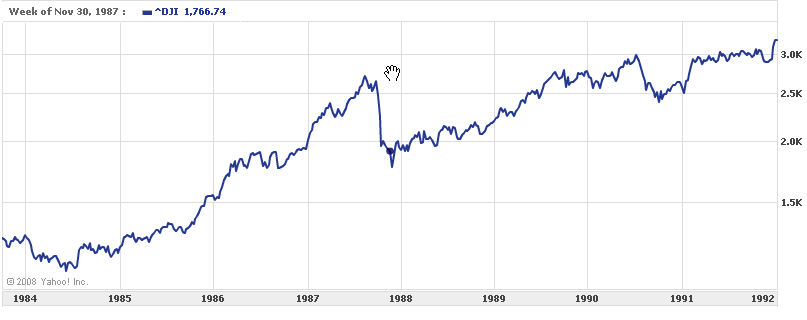
1. Good: The market enjoyed a relatively quick recovery after the 1987 crash, surpassing the 1987 peak by mid-1990. Could we be so lucky this time?

2. Bad: The Dow peaked near 1000 in 1966, and then went on a rollercoaster ride, never permanently crossing 1000 until 1983! That’s an effectively flat market for 17 years.

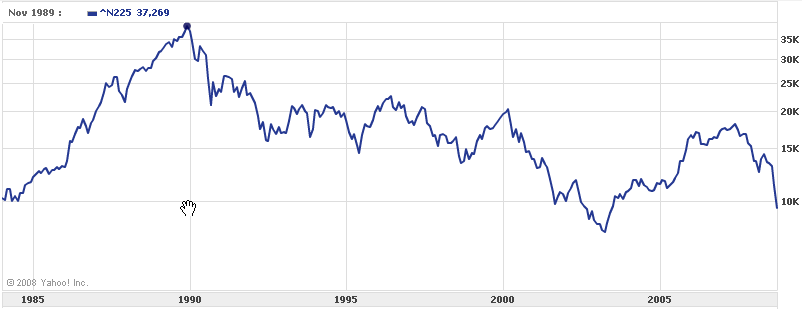
3. Ugly: Japan’s phenomenal postwar growth and an associated bubble peaked with the Nikkei index above 37,000 in 1989. The Nikkei subsequently crashed, and is now trading at the same levels as in 1983, 25 years ago! If this sounds impossible, consider that Japan’s bubble was fueled by reckless lending and a real estate bubble, and that Japan resorted to fiscal stimulus and banking system intervention not dissimilar to the global approach today.

While no one can be certain, I think the middle scenario is not unlikely. Given that the current bear market is now dated to have begun 8 years ago, with the dot com bust, we may still have another decade to go.

We Need a Good Recession

“I believe if the credit markets are not functioning, that jobs will be lost, that our credit rate will rise, more houses will be foreclosed upon, GDP will contract, that the economy will just not be able to recover in a normal, healthy way.”Ben Bernanke, Fed Chairman, Sept. 23rd, 2008

“that our American economy’s arteries, our financial system, is clogged and if we don’t act the patient will surely suffer a heart attack — maybe next week, maybe in six months, but it will happen.”Hank Paulson, Secretary of the Treasury, Sept. 23rd, 2008

Even before testimony concluded yesterday on Capitol Hill, reports with headlines like “Bernanke: Recession Certain in Absence of Bailout” and “Bush Administration Tells Congress to Act Quickly or Risk Recession” hit the wire services. Both Ben Bernanke and Hank Paulson stated clearly that a recession would occur if the proposed $700 Billion dollar bailout plan were not enacted. Similar threats of recession were used earlier this year when President Bush and Congress enacted a tax rebate stimulus program.

Let me ask a simple question: why is everyone so afraid of a recession? Recessions and boom times are both natural parts of the business cycle in market economies, and the United States experienced twenty recessions (including the Great Depression) in the 20th century alone. Economic downturns, with the associated bankruptcies and layoffs, help trim inefficient investments made at the peak of economic cycles, thus paving the way for the next round of economic growth.

The alternative to business cycles can be found in state-controlled economies, where inability to reallocate capital to new enterprises slows overall economic growth dramatically. Governments presiding over market economies also attempt to tamper with business cycles, and while intervention may soften the landing in a recession, it may also delay the recovery. Japan’s “lost decade” of the 90’s, where poor economic growth was the norm, resulted after Japan’s incredible economic boom of the 80’s. The extraordinary length of Japan’s recovery stemmed partly from the Japanese government’s inability to allow corporate and bank bankruptcies progress at the rate needed to clear out bad loans and start a new economic cycle.

The US would do well to heed Japan’s allegory. Ideally, any intervention in the financial markets should enable orderly collapse and restructuring of businesses overridden with bad debt. No one gains in a financial panic, but an unwinding of the excesses of the US housing bubble is inevitable. Creative Destruction is at the heart of the business cycle, it’s at the heart of the American economy, and it will be necessary in this cycle as well. Let’s not make it take longer than necessary.