How Do We Limit Bank Risk?

President Obama recently proposed a tax on some of major banks’ liabilities to pay for TARP-related (bank bailout) losses, and to reduce risk taking by big banks. While the proposed tax might accomplish the former goal, analysts have opined that it is unlikely to decrease financial risk-taking. Regulation might decrease risk-taking, but it doesn’t resolve the issue of paying for past losses, nor does it establish a reserve for any future risks. Is there a better way to reduce risk taking while simultaneously paying for losses past, present, and future?

Why not consider a financial leverage tax on all corporations? The US has historically encouraged debt, which helped fuel the recent credit crisis. A tax on leverage would help penalize excess risk taking by taxing the very fuel that feeds the fire. While it’s perfectly acceptable for any company to gamble with their own equity, systemic risks are created when institutions bet in the trillions by borrowing dozens of times their own capital. That’s precisely what Lehman Brothers and other investment banks did during the boom years, with leverage ratios well over 40 times their own capital. A tax on financial leverage that increases taxation as a function of leverage would allow companies to take on risk while penalizing the Lehmans that took excessive risk with borrowed money.

How would a financial leverage tax work? The tax rate would be based on the debt-equity leverage of the company, so that the tax rate would rise with leverage. The tax might not apply to the first billion dollars in liabilities, so that it would affect only larger corporations. Assume the base tax rate is 0.03% of liabilities. A large non-financial company with $10B in debt and a debt-equity ratio of 1 would have to pay $3 million in taxes [1]. A bank with $10B in liabilities and $1B in equity would have to pay ten times that amount as a result of its 10x leverage, resulting in a tax bill of $30 million. If the bank lends out 10 Billion with a 3% interest margin, it would earn $300 million in net interest. For this bank, the leverage tax would effectively be 10% of net interest income [2].  On the other extreme, under this tax regime a company like Lehman would have had to pay 1.2% of its gross liabilities, which were in the neighborhood of $700 Billion. This would amount to $8B per year, double Lehman’s 4B net income in 2007 [3]!

The financial leverage tax would make it impossible for banks, corporations, and hedge funds to create the kind of credit bubble they created in the mid 2000s. Funds raised by such a tax could be used to pay off the TARP bailout, and also to fund the SEC and other enforcement agencies. The benefit of this approach is that it could be applied across the economy in a uniform way. Current proposals don’t apply to hedge funds and other highly leveraged non-bank institutions, leaving pockets of risk to grow. Excess financial leverage has fueled almost every major financial collapse in history, and a tax on leverage would directly address this issue.

[1] 0.03% of $10 Billion is 10 Billion * 0.0003, or $3,000,000. In the case of the bank with 10x leverage, this figure goes up by a factor of 10, to $30 million

[2] The St. Louis Fed tracks net interest margins of US banks, and they have been above 3% over the last 30 years, making this a very conservative estimate. A leverage tax of $30 Million would be 10% of the bank’s net interest of $300 Million.

[3] At 40x leverage, the leverage tax in the example given would be 1.2% of gross liabilities. With net interest margins around 3.5%, a 1.2% tax would consume about 1/3 of a bank’s interest. Since a bank’s operating expenses and loan losses often consume more than 50% of net interest, this tax rate would likely cause a bank with this kind of leverage to be unprofitable – which is precisely the point.
The Saints’ Long March

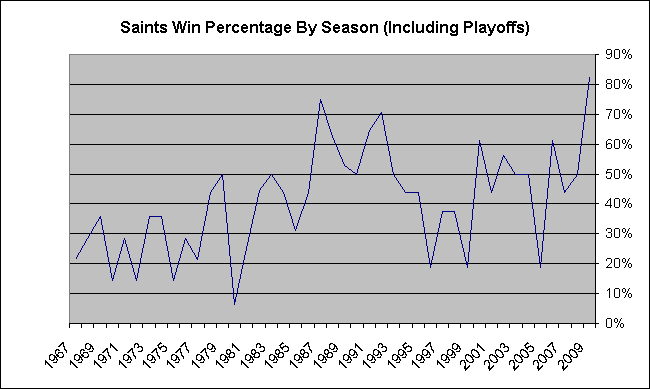
For most of their history, the New Orleans Saints have actually been the worst franchise in American sports history [1] – though that didn’t stop me from becoming a die-hard fan. The Saints didn’t even have their first winning season for twenty years after joining the NFL, and didn’t win their first playoff game until 2000, 33 years after inception. With the current season offering long-suffering Saints fans their best ever shot at a Super Bowl and a championship, I thought I’d take a look back at how far today’s Saints have come, in graphs:

This graph, showing the Saints winning percentage by decade, makes the progress more obvious:

With the incredible (still going!) season that the Saints are having, we have closed out our first winning decade! This is a far cry from the 60’s and 70’s teams that typically won 3 games a season. Here’s to establishing a tradition of winning in New Orleans, starting in Miami this year!

[1] On what grounds do I, a loyal Saints fan, categorize the Saints as the worst franchise in sports for most of their history? For starters, the Saints were the last team in the NFL to win a single playoff game (exluding the Texans, whose history is only eight seasons long). When looking at other sports, consider that even the Los Angeles Clippers have been to the postseason as many times as the Saints, and they did it in fewer seasons.

All data for the graphs can be found here.

HiddenLevers.com – Scenario Analysis For Investors

I’d like to announce  a new project that I’ve been working on called HiddenLevers.

What happens to your portfolio if interest rates rise to 10%? What about if oil prices spike up to $150 per barrel? Do know what impact health care reform could have on your portfolio?

HiddenLevers.com will help you answer those questions and more, by making Scenario Analysis easy for investors. By connecting big-picture economic factors (levers) with stocks and industries, HiddenLevers helps investors to understand how different economic scenarios can impact their investments.

You can use HiddenLevers to:

Try HiddenLevers out – we think it will add another valuable angle to your investment planning and research! HiddenLevers is currently in beta mode, so don’t hesitate to leave feedback to help improve it.

US Economic Energy Efficiency 1950-2008

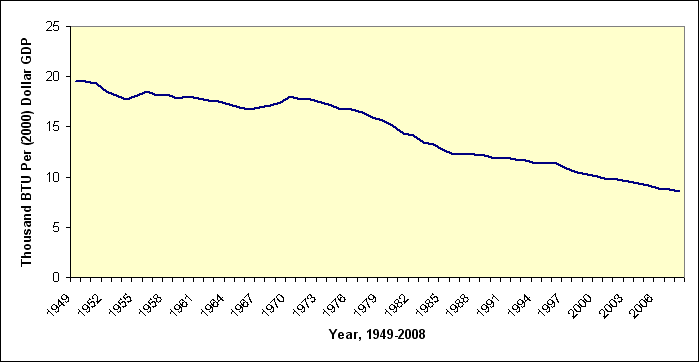
How is energy related to economic output? Energy is the underpinning of all modern society, as our economy and society would grind to a halt without gasoline, electricity, and other similar forms of energy [1]. Since energy plays such an important role in the nation’s economic health, the Energy Information Administration (EIA) has been measuring energy inputs into the economy for decades, and uses this data to calculate the economic energy efficiency (energy intensity) of the economy. The EIA measures the BTU used to produce one dollar of GDP over time. By this measure the US economy has become significantly more efficient over the last six decades, using half the energy to produce a dollar of output today than it did in the 1950’s:

As the above graph illustrates, the amount of energy (in BTU) required to produce a dollar of GDP has been dropping steadily, from close to 20,000 BTU in 1949 to 8,500 BTU in 2008. Just how fast has that drop been occurring?

This graph illustrates the rate of annual efficiency gains from 1950 onward, measured as the increase in dollars of GDP per thousand BTU [2]. During and after periods of high energy prices, energy efficiency rose quickly, as in the late 70’s and early 80’s, and again from 2002 until today. Overall, the mean rate of annual energy efficiency gains in the economy is 1.44%. At this rate, the energy required to produce a dollar of GDP drops in half every 50 years [3]. Can the US do better? At its peak in 1981, annual energy efficiency rose by 5 percent. Sustained annual increases of 5% would halve the energy intensity of the economy in less than 15 years! In other words, the US could maintain its current $14 trillion dollar economy while using half the coal, oil, and natural gas that it uses today.

More realistically, the US might attempt to match the efficiency gains it racked up from 1978 to 1985, when annual efficiency increases averaged 3.3%. Sustaining this pace would halve energy intensity every 20 years. With even the more optimistic predictions of the EIA and IEA indicating a potential oil supply crunch in the next few decades, reducing energy intensity is key to maintaining and improving world prosperity. For the US, many of the easy gains are gone, as outsourcing manufacturing improved US efficiency by moving energy intensive industries overseas. Further decreases in energy intensity will have to come from actual increases in energy efficiency, and from an increase in the quantity and relative value of low-energy products like online services and media [4].

What about a pessimistic scenario like peak oil? How much impact can energy efficiency have in this scenario? Assume that the US can halve BTUs per dollar of GDP again by 2050, through a combination of increases in thermodynamic efficiency and increases in low-energy goods and services [4]. This would only require a 1.75% annual increase in efficiency, not far above the historical average of 1.44%. A number of peak oil predictions indicate that oil production will be roughly half what it is today by mid-century. But energy efficiency increases alone could enable the US to sustain its current GDP at mid-century on half the oil! While a world of zero economic growth is alien today, it’s a far cry from the end of civilization as we know it. As long as renewable energy growth exceeds population growth, continued economic growth may even be possible in this worst of cases.

[1] When thinking about how a lack of energy would affect US life, imagine America without electricity, gasoline, and natural gas. The US as we know it would cease to exist. Also, strictly speaking, gasoline is not energy, but it and other fuels are often measured in terms of the BTU of combustion energy they contain.

[2] Here’s the spreadsheet with data. It makes more sense to look at the percentage rate of increase in dollars per BTU, instead of looking at the rate of decline in BTU per dollar. People can interpret positive growth rates more easily than negative decline rates, and so the data was graphed in this way. To do so, I inverted the data from the first graph (from BTU/dollar to dollar/BTU), and then measured the rate of change of the resulting data.

[3] At a compound annual growth rate 0f 1.44%, in 50 years the number of dollars per BTU will roughly double, which is the same as halving the number of BTU required to produce a dollar of GDP. 1.44^50 ~= 2. Similarly, an annual growth rate of 5% doubles efficiency in 15 years.

[4] The energy efficiency of an economy can be improved in two ways. First, the thermodynamic efficiency of energy production, conversion, and distribution can be improved, as discussed in this blog post. Thermodynamic energy efficiency can only be improved so much, as hard physical limits exist. But an economy’s energy intensity also decreases when goods and services that use energy less intensively become more common. For instance, email is much less energy intense than physical mail, and has in fact replaced a large percentage of physical mail. The entire media industry is much less energy intense than it was in the 19th century, when all media had to be consumed in person (at a concert/theater) or on paper. Consider also the difference in energy content between two different services: a $200 flight, and a $200 salon visit. If the US economy evolves in a way that makes it less energy-intense while still providing benefit to its citizens, this will generate substantial “economic” energy efficiency.