How to Balance the Federal Budget

Can the US federal budget be balanced? It is obviously physically possible to balance the budget by either lowering spending, raising taxes, or a bit of both. But can the budget be balanced in a manner that is fiscally prudent while maintaining adequate funding for government’s most important operations?

I have attempted to balance the 2008 budget below while obeying the following constraints:

  1. No tax increases
  2. No spending shifts between departments, only spending cuts
  3. All spending, including entitlements spending, is fair game

The actual federal deficit for 2008 was $459 Billion, which forms the goal for the cost cutting exercise outlined in the table below [1].

Category 2008 Spending ($Billions) Proposed Cuts Proposed Spending
Defense 612 Cut by $150 Billion, maintaining US defense spending at a level that exceeds the entire World excluding NATO. [2] 462
Social Security 612 Phase out social security benefits for upper income seniors, cutting roughly $110 Billion annually. [3] 500
Medicare + Medicaid 587 Introduce 20% coinsurance for medical spending above $40,000 per year for Medicare and Medicaid recipients, saving $110 Billion. End Medicare Advantage subsidies, saving $17 Billion. [4] 460
Non-defense Discretionary 508 Make an across-the-board 9% cut in non-defense discretionary spending, saving $46 Billion. [5] 462
Other Mandatory Programs [5] 411 End agricultural commodity subsidies and crop insurance subsidies, saving $15 Billion. Modify student loan programs to cut out private middlemen, saving $9 Billion. [6] 387
Interest Payments 253 This cannot be cut without a US government default. 253
Totals 2,983 459 2523

As the table shows, the US federal budget cannot be balanced without deep cuts in Medicare/Medicaid, Social Security, and the Department of Defense. Roughly 60% of the budget is allocated to these major programs, making a balanced budget impossible without reductions here.

A rationale for each major budget cut is provided in the footnotes below. I invite readers to share their balanced budgets as well, or to suggest changes in the cuts that I’ve suggested. Just make sure that the numbers add up, as cutting $459 Billion from the federal budget is harder than it looks!

[1] The core budget data for the table comes from Table S-3 of the US Budget Summary Tables. The 2010 budget document is used, as actual spending for 2008 is not available in earlier versions. The 2009 fiscal year data is incomplete, and also has significant one-time items like TARP and Stimulus package spending, so I chose to focus on the finalized 2008 numbers instead.

[2] The US defense budget represents almost 50% of the entire world’s defense spending, leaving ample room for cuts without jeopardizing US security. Over time the US defense apparatus has become particularly bloated, and cuts may actually improve the DoD’s efficiency over time. It’s worth noting that the US won the Cold War with much lower defense budgets than today.

[3] Social Security was enacted to ensure that American seniors did not starve in their last years, but later grew into a mandatory retirement program. Cutting Social Security payments to upper income seniors would bring the program closer to its original goal. There are 5 million senior households with income greater than $50,000, and they represent the top 20% of all seniors in income terms. These seniors likely draw maximum social security benefits, around 30k annually if there is slightly more than one senior per household on average.  Phasing out these benefits for the wealthiest 20% of seniors would save around $110 Billion. Gross benefits reductions would be around $150 Billion (5 million * 30,000), with an offsetting loss of tax revenue from the reduction in benefits.

[4] Along with defense spending, Medicare and Medicaid are the fastest growing parts of the federal budget.  Since government resources are limited, government benefits must also be limited. Medicare and Medicaid spending can be contained by requiring individuals to pay 20% of their own health care bills beyond $40,000 per year. This change would affect only 5% of Medicare recipients, but would yield huge savings as many patients would decline expensive treatments once cost became a consideration. 32% of all Medicare spending occurs above the $40,000 line; if requiring coinsurance cut this in half, roughly $110 Billion would be saved. This analysis assumes that the breakdown in Medicaid spending is similar to that of Medicare.  An additional $17 Billion annually could be saved by ending subsidies to Medicare Advantage, which is part of current health care reform proposals under debate.

[5] Non-defense discretionary spending includes almost all other federal departments. A 10% across-the-board cut would force all departments to shrink and increase efficiency. Alternately, targeted cuts could be used to shrink certain programs, but these cuts would still have to total $51 Billion annually. Health care cost growth could be reined in through heavy cuts at the NIH, which heavily subsidizes health care and pharmaceutical research. Cutting NIH’s $30 Billion budget in half would enable other departments to get by with a 6% cut instead. One more alternative would involve eliminating Congressional earmarks, which would reduce spending by $20 Billion.

[6] Other Mandatory Programs includes federal funding for food stamps, unemployment insurance, farm subsidies, student loans, veterans’ benefits, and other miscellaneous programs written into law with automatic spending formulas. Farm subsidies in particular deserve heavy cuts, as they distort the economy while worsening Americans’ health. Eliminating commodity crop payment programs and crop insurance subsidies would save $15 Billion annually (see page 4). An additional $9 Billion in savings is possible through the removal of middlemen in federally-backed student loans. Since the federal government assumes all risk on these loans, there’s no reason to compensate private banks to issue the loans.

Is Local Really Greener Than Global?

Environmentalists have decried the long supply chains of the globalized world, asserting that they are responsible for significant excess pollution and waste when products could be produced locally instead. With the recession and rising unemployment, support for buying domestic also takes on a political slant, as cries for protecting local jobs mount. But when it comes to the environment and emissions, which is really worse? Is the simple assumption that buying local is always better correct?

Cost of Shipping by Land, Air, and Sea [1]

Transport Mode Cost (Cents Per Ton-Mile) Emissions (CO2 Grams Per Ton-Km)
Airplane 81 570
Truck 27 252
Railroad 2.24 200
Barge/Ship 0.72 52

Shipping goods by plane is obviously most expensive, but it’s the difference between shipping by truck, rail, and ship that stand out. Shipping a ton of freight by truck is 35 times more expensive than shipping it over water. While railroads are much more efficient than trucks, shipping by rail is still three times as expensive as barge shipping. Goods from China travel roughly 7000 miles on ship to reach California, but that distance can be covered at the same cost as only 200 miles by truck! Since most store-bound products in the US travel via truck, it’s clear that the ocean voyage is a smaller part of globalization’s environmental impact than is commonly suspected.

In calculating the environmental footprint of wine, National Geographic and LiveScience have both noted a study on the same phenomenon: a New Yorker causes less environmental impact by drinking a bottle of wine from Bordeaux than by drinking a bottle of California wine!

These calculations don’t take into account the environmental impact of production, which varies by product and country of origin. A worker in the US uses far more energy (and creates more pollution) than a worker in China, simply because his standard of living is higher. Even if a US factory is run more efficiently, a US worker owns more cars, a larger home, and drives longer distances to work than a Chinese worker who lives in a dormitory at her factory. While an exact calculation of emissions by product is laborious, it’s easy to see that the cut-and-dry notion that local goods are more environmentally friendly is questionable at best.

[1] Data for the table were source from the  US Bureau of Transportation Statistics. Since shipping cost data were not available for all transportation modes after 2001, 2001 data were used. The emissions data comes from Dr. Vino’s wine study, which in turn sourced these figures primarily from the Greenhouse Gas Protocol.

What Percentage of US Healthcare Is Publicly Financed?

Public, taxpayer-funded health care spending will pay for for 53% of US health care in 2009. If health care tax breaks are included, this figure rises to 62%.

Of the $2.5 Trillion dollars expected to be spent in the United States on health care this year, what percentage is paid by taxpayers? The Kaiser Family Foundation calculates that 46% of health care spending was publicly financed in 2006, but this number seems to exclude health care for government employees. The Center for Medicare & Medicaid Services collects data on health care spending in its National Health Expenditure survey, which can be used to perform a direct calculation on the government share of health care financing. The following table summarizes the 2007 NHE data, the latest year for which a detailed breakdown is available:

Category Amount (2007 $ Billions)
Medicare [1] 418
Medicaid (Including State Funding) 340
Other Public Health Programs [2] 189
Federal, State, and Local Employee Health Care 134
NIH and FDA Budgets [3] 32
Total Public Spending 1113
All Private Health Spending 1018
2007 Total US Health Spending 2131

The 2007 data show that 52% of all health care in the United States is publicly financed. The NHE data also show that from 1987 to 2007, the government’s share of health care financing has risen by ten percentage points, or about half a percentage point per year. This means that in 2009, the public share of health care spending is likely at 53%, or perhaps higher as a result of rising unemployment due to the recession. If health care subsidies (primarily tax exemptions) are included as government financing of health care, they add another $200 Billion to the total, raising the government’s share of health care spending to 62%.

With the government already paying for the majority of US health care, one thing is clear about the current health care reform debate: The debate is not about whether the government will take control of the health care system, as that has quietly taken place over the last 40 years. The real debate is about how the government should distribute its health care spending, and on whether it will be able to rein in endless health care cost growth.

[1] The detailed NHE data split up by source of payment can be found here:

In calculating the numbers in the above table, I used Table 1 in the pdf. I allocated all costs associated with Medicare to the public sector, unlike the table in the pdf, which counts Medicare premiums and contributions as private sector payments. From a standpoint of determining government involvement in the health care system, it makes more sense to count all Medicare dollars as public financing, particularly since paying Medicare taxes is precisely how most of the Medicare system is funded!

[2] According to the NHE pdf, other federal, state, and local health programs “Includes maternal and child health, vocational rehabilitation, Substance Abuse and Mental Health Services Administration, Indian Health Service, Office of Economic Opportunity (1965-74), Federal workers’ compensation, and other miscellaneous general hospital and medical programs, public health activities, Department of Defense, Department of Veterans Affairs, and State Children’s Health Program (SCHIP)” and “Includes other public and general assistance, maternal and child health, vocational rehabilitation, public health activities, hospital subsidies, and state phase-down payments.”

[3] The NIH budget is $30 Billion, and can be classified entirely as health care spending, though it’s often left uncounted. But isn’t research to cure disease health care spending? If it’s not, then what exactly is it? I have also included two-thirds of the FDA budget, as that is the portion related to drug and medical device supervision.

Total Energy Efficiency Of The US

The US economy is only about 33% energy efficient today, with two-thirds of primary energy production lost before it’s put to use. Energy efficiency improvements will be a huge part of sustaining economic growth moving forward.LLNL_US_EFC_20081

What is the total energy efficiency of the US economy? More precisely, what percentage of primary energy input, whether from fossil fuels or renewables, is actually used for our benefit? The Lawrence Livermore National Laboratory (LLNL) studies energy flows within the US economy, and produces the diagram above annually. For 2008, LLNL calculates that the nation’s energy efficiency is roughly 42%, with the remaining 58% of energy lost primarily as wasted combustion heat [1].

By itself, having a 42% efficient economy indicates that significant improvements in our energy security are possible through efficiency improvements alone. But there is ample evidence that the US is significantly less efficient than the diagram indicates. One key assumption in particular biases the calculation: LLNL assumes that residential, commercial, and industrial users of energy are 80% efficient in their end use of energy. The primary uses of energy in American homes are heating, cooling, and water heating, and these activities are closer to 50% efficient than 80% efficient in the average American home [2]. Even the most efficient lighting is only about 20% efficient, and huge number of computers and gadgets using and powering the internet can be incredibly inefficient [3]. While industrial users of energy have an economic incentive to prevent waste, they can’t avoid the inefficiencies inherent in lighting and mechanical engines. Finally, transportation in the US is probably closer to 20% efficient, rather than 25% as used in the LLNL study [4].

In place of the 80%  efficiency used by LLNL, we can substitute a 50% efficiency estimate for residential and commercial users, a 75% estimate for industry, and a 20% estimate for transportation. Using these estimates of end-use efficiency, total energy efficiency in the US economy is around 33%. The US has huge room for improvement, which should provide hope for our energy future. If the US were able to improve its energy efficiency from 33% to 50%, primary energy usage could be cut by a third. The US could supply today’s annual energy needs with 67 quads (quadrillion BTU) instead of 102 quads. That’s $650 Billion worth of energy at today’s prices [5]!

During the energy shock of the late 70’s and early 80’s, the US decreased the energy intensity of its economy by as much 5% per year. Given the dual constraints of rising world energy demand and Peak Oil, a similar effort may be required soon. It’s good to know that the US has plenty of room to improve, and to know that improvements in efficiency can generate huge savings.

[1] Neither the economy nor even a single power plant can ever by 100% energy efficient. The heat engines (internal combustion engines, fossil-fuel power plants, etc) used to run most of modern society cannot exceed certain theoretical limits governed by the laws of thermodynamics, so that even the most efficient combined-cycle power plants today are only about 60% efficient.

[2] American residential energy use is dominated by hvac usage and water heating, as the EIA shows in table 14 of its energy usage survey. Household furnaces range from 65% to 90% in efficiency, but the typical house loses 25% of its heat through its windows alone, so that heating a house is perhaps 50% efficient overall. Gas water heaters are 50-70% efficient. None of these numbers take into account time when a home is unoccupied, when energy efficiency is effectively 0% if systems are not turned off.

[3] Incandescent light bulbs aren’t even 5% efficient, while fluorescent bulbs reach around 15% efficiency. During the summer and in warmer parts of the country, the majority of the energy used in lighting (lost as heat) must be counteracted with air conditioning! Computers and data centers are also incredibly inefficient, particularly when measured from a standpoint of average cpu utilization. Servers in data centers are typically configured with enough cpu power to sustain peak activities like handling the Christmas rush at an ecommerce website. As a result, they spend most of their time at very low average utilization, and probably run at less than 10% energy efficiency.

[4] Internal combustion engines are only about 20% efficient in real-world driving conditions, and this may not take into account extraordinary efficiency losses caused by traffic jams, which themselves result in billions of dollars worth of economic losses annually.

[5] The EIA Kids’ page provides convenient numbers on the BTU content of different fuels (if only adults knew this much!). We can calculate the rough average price of a BTU by averaging the cost per BTU of oil and the cost per BTU of coal. According to the EIA, a ton of coal costs roughly $50, and contains 19.98 million BTU, for a cost of $2.50 per million BTU. A barrel of oil costs roughly $80 and contains 5.8 million BTU, for a cost of $13.80 per million BTU. A simple average gives us a price of roughly $8 per million BTU. Saving 35 quadrillion BTU of energy with changes at power plants thus equates to a savings of $280 Billion per year. If the energy efficiency changes occur at the point of end use, however, the savings could be much greater, since higher value forms of energy like electricity are much more expensive.  One kilowatt-hour of electricity equates to 3412 BTU, and costs roughly 10 cents, which equals $29.30 per million BTU. If the 35 quadrillion BTU of energy efficiency savings all occur at point of end use, approximately $1 trillion in annual savings are possible! In reality, efficiency gains will occur across the system, so an average of the two estimates yields a savings estimate of $650 Billion per year.

Why Oil And Gas Are Different

Peak Oil occurred in the US in 1970, but a new record for natural gas production may be set soon. This divergence explains why oil’s value grows while natural gas’ value declines.

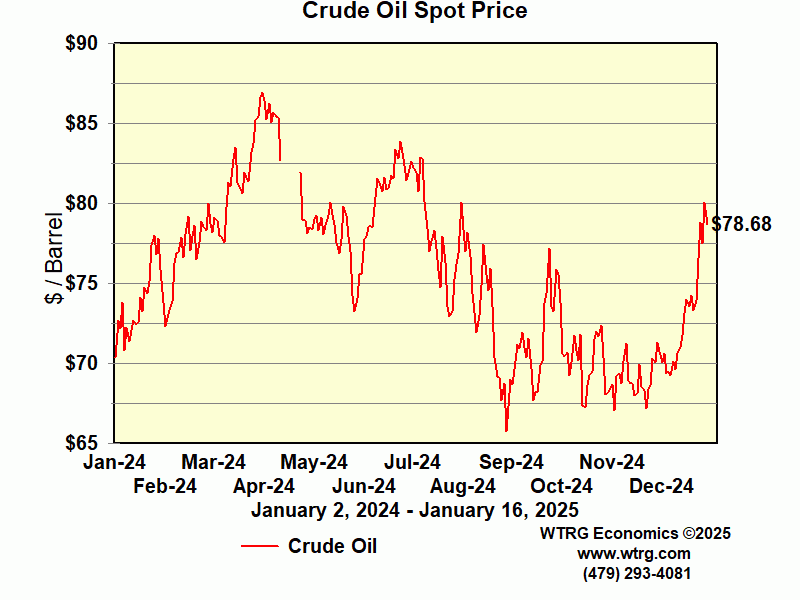
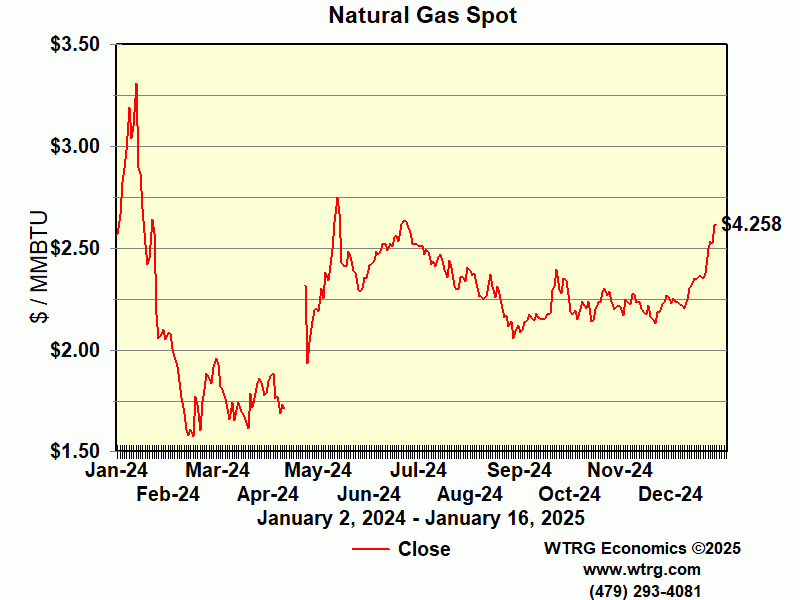
Oil prices have bounced back from lows in the 30’s earlier this year to around $80 per barrel today. Natural gas prices, meanwhile, have recovered less from summertime lows, from below $3 per Million BTU to $4 today. Oil and gas prices are historically correlated, as the two fossil fuels are often produced from the same wells and share overlapping uses in industry, residential heating, and other sectors. Why have prices for these commodities decoupled, and will this continue in the future?

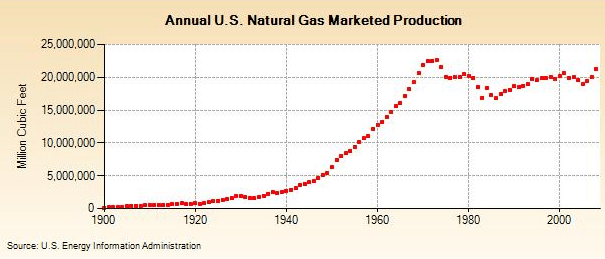
Here are two graphs, depicting long term US production of oil and natural gas:

US Oil Production

Since its peak in 1970, US oil production has declined from 9.6 million bpd (barrels per day) to 4.9 million bpd, a decline of 49%.

US Natural Gas Production

Natural gas production set a record of 22.65 TCF (trillion cubic feet) in 1973, but 2009 is on pace to reach within 3% of the old record, and 2008’s production of 21.26 TCF is only 6% less than record.

The long term histories of the two fossil fuels show a fundamentally divergence in path. Domestic oil production peaked decades ago, while natural gas production is poised to set a new record if  the market demands it. While Peak Oil is now in the rear-view mirror in most countries, and could be quite close worldwide, Peak Natural Gas has yet to even occur domestically. In addition, oil status as the world’s primary transport fuel is proving difficult to change [1], while natural gas competes against coal, nuclear, and renewables in the market for electricity production. This situation explains the breakdown of the historic price relationship between oil and natural gas, which is unlikely to return soon.

[1] The EIA projects that 3% of new car sales in 2030 will be PHEVs, or plugin hybrid electric vehicles. Even if PHEV sales accounted for 100% of all new car sales, it would take twenty years to replace all existing cars on the road (since the US has over 200 million vehicles and annual car sales around 10 million). The EIA’s projection makes it clear the PHEVs won’t have a significant impact absent an oil price shock that forces a change in behavior.